Chatbot, AI agent or automation: what your business actually needs
When a company calls me saying "we'd like to add artificial intelligence", nine times out of ten the first half hour goes into working out which of three very different things — all sold today under the same name — they actually need. Chatbot, AI agent and automation are not synonyms, they cost very different amounts and they solve different problems. Picking one for the wrong reason is the fastest way to burn budget and conclude that "AI doesn't work".
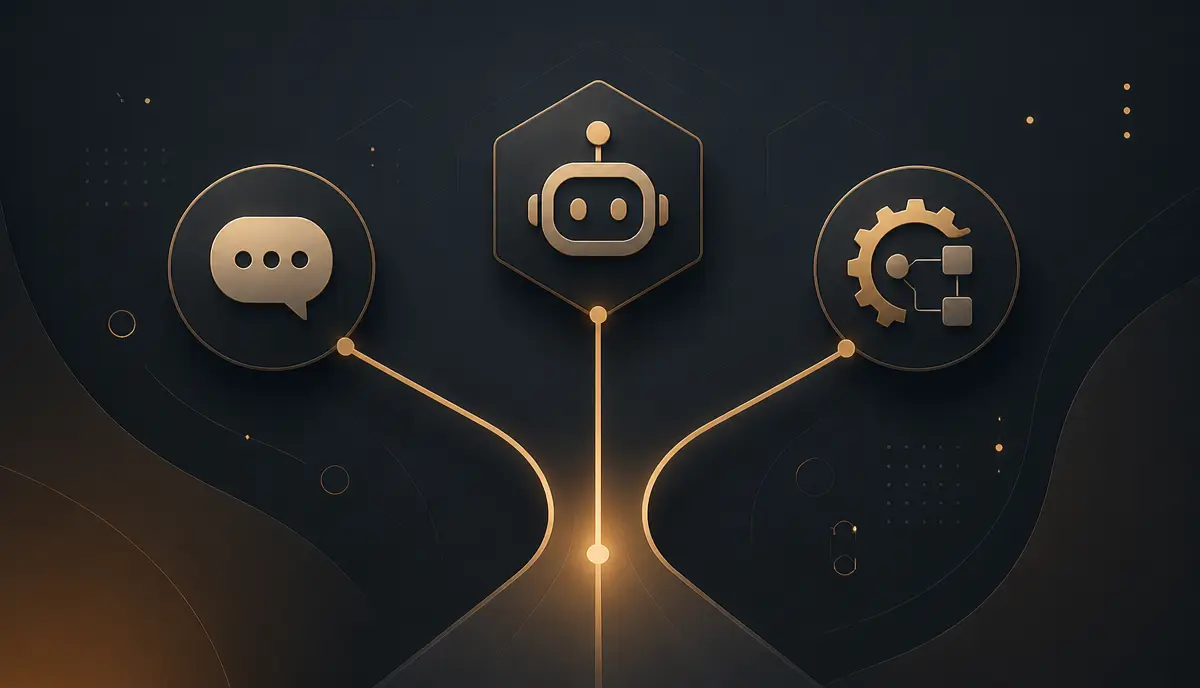
The chatbot is the simplest form: it answers questions. It sits on your website or WhatsApp, knows your content — price list, opening hours, terms, FAQs, manuals — and returns it in natural language. It does nothing inside your systems: no orders, no data changes, no decisions. It's useful when you get a lot of repetitive information requests and few actions to perform. It's also the cheapest project, and in most cases it ships in one or two weeks.
Automation, at the opposite end, talks to nobody: it executes. It's a flow triggered when something happens — an invoice arrives, a customer fills in a form, an order changes status — and it runs a defined sequence: move data between systems, generate a document, update the CRM, send a notification. It doesn't need artificial intelligence to work, and that's the part almost nobody says out loud: a large share of the problems SMBs blame on the lack of AI is solved by a deterministic flow that costs less, never guesses and has no token bill.
The AI agent sits in between, and it's the category that needs the most care. An agent receives a goal, not a path: it interprets an unstructured request, decides which tools to use, uses them — read the ERP, write to a database, send an email — and checks the result. You need it when the input is ambiguous and cases are too varied to be written as rules: a free-form quote request, a fault report to classify, a document to read and turn into structured fields. It's the most powerful tool and also the most expensive to design properly, because you must define what it may do alone and what it may not.
The practical rule I use: if the process can be drawn as arrows without ever using the word "depends", it's automation and should be built without AI. If it contains free text written by a human that must be interpreted, you need a model. If on top of interpreting it must also act on your systems, then it's an agent. And if the user expects a conversation, a chatbot interface goes on top — but that's the tip of the iceberg, not the project.
On cost, honest orders of magnitude for SMB projects: a well-built informational assistant connected to your content usually falls between 1,500 and 4,000 euros; an automation across two or three systems between 2,000 and 6,000; an agent that interprets and acts, integrated with the ERP and human-supervised, from 4,000 to 12,000 euros, plus recurring costs that at these volumes stay in the range of a few tens of euros a month. The detailed breakdown is in the article on what an AI agent costs a company.
The mistake I see most often isn't choosing the wrong tool: it's choosing the right tool for a process nobody ever tidied up. If the price list exists in three versions in three folders, if customer requests arrive on five channels that don't talk to each other, if there's no written rule about who approves what, then any technology will amplify the mess instead of fixing it. The first half day of a serious project is spent looking at how the work happens today, not choosing a model.
The second mistake is starting too big
An agent covering the entire sales cycle is a months-long, high-risk project; the same agent limited to a single, most frequent request type goes live in three weeks, produces real numbers and funds the next step. In practice, almost every project that works started from a small, measurable piece.
If you're unsure which of the three categories you need, here's the shortcut: take the process that wastes most of your time this week, write in five lines what happens from start to finish, and count how many times a person has to read something and decide. Zero times: automation. Many times, on free text: agent. Only questions and answers: assistant. From there the choice almost makes itself — and if you want an opinion on your specific case, send me those five lines: they're usually enough to say what's worth doing and what isn't.
Frequently asked questions
How do I know whether I need a chatbot or an agent?
If requests are repetitive questions with known answers, a chatbot is enough. If the system must read data, decide and act (open a ticket, build a quote, place an order), you need an agent.
What is the most common mistake?
Picking the right tool for the wrong process, and starting too big. One measurable process shipped to production beats a company-wide project on paper.
What do the three options cost?
An FAQ chatbot costs a few hundred euros, automation starts at €1,200, a vertical AI agent connected to your systems runs €2,500–8,000 in most SMB projects.
Davide Stigliani
Full-stack developer and AI agent specialist — Tolve (PZ), Basilicata, Italy
I build AI agents, n8n automations and full-stack web applications for SMBs, connecting them to the ERP, CRM and channels the company already uses. I work across Italy and abroad, on site in Potenza and its province.