AI assistant for customer email and WhatsApp: reply in a minute without hiring
In many small and medium businesses the sales inbox is the real operations centre of the company, and also its most fragile point. Quote requests, chasers, orders, complaints, technical questions, curiosity and spam all arrive mixed together, and one or two people sort them by hand between phone calls. On WhatsApp it's worse, because the customer expects an answer in minutes. The cost of this situation doesn't show up in the accounts, but it shows in response times and in the requests that sit unanswered for two days.
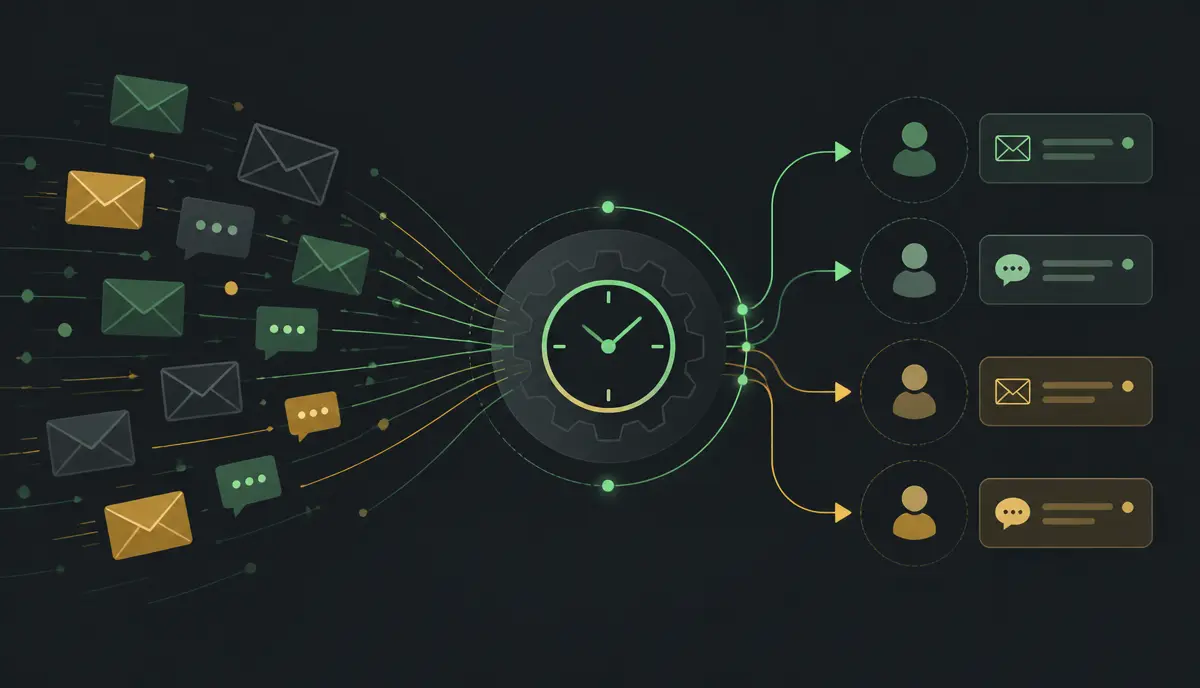
A well-designed AI assistant isn't there to "answer for you": it's there to remove the triage and first-draft work, which is repetitive and eats most of the time. The flow reads every incoming message on email and WhatsApp, understands what it is and classifies it: sales request, support on something already sold, admin matter, supplier, irrelevant. That alone changes the day of whoever runs the inbox, because urgent things stop hiding among the rest.
The second level is enrichment
Before handing a message to a person, the assistant pulls the context: who this customer is, what they bought, whether a case is open, whether invoices are overdue, what the last exchange was. The request reaches the salesperson or technician with everything needed to reply, instead of requiring three searches in three systems. This is the step users appreciate most, and it's also the one no generic chatbot can do without integration to your data.
The third level is the draft reply
For repetitive categories — delivery times, terms, documents to send, technical questions already covered by the manuals — the assistant prepares a complete reply in the company's tone, quoting the correct data, and holds it for approval. The person reads, corrects if needed and sends. Time per reply drops from minutes to seconds, and quality tends to rise because the answer always carries the right information.
The fourth level, which I recommend enabling only after a few weeks of running in, is automatic replies on a narrow, safe subset: acknowledgements with a realistic timeframe, sending standard documents, answers whose source is an approved company document. Anything involving off-list pricing, complaints, contractual matters or customers in dispute must stay with a person, always. An assistant that can say "I'll pass this to a colleague" is worth more than one that tries to answer everything.
Realistic results, no exaggeration: where I've seen these flows work, the most solid gain is the time removed from triage and context hunting, which in busy inboxes is the heaviest item; next comes first-response time, typically going from hours to minutes; and finally the disappearance of lost messages, the least quantifiable benefit and often the first one the owner notices. What does not happen is replacing a person: the work changes shape and concentrates on the cases that matter.
On cost: a triage-and-enrichment assistant across two channels, connected to the CRM or ERP, generally falls between 3,000 and 8,000 euros to build depending on integrations and the number of categories, with recurring model costs that stay modest at SMB volumes. If you also need document-based reply generation, add the preparation of the knowledge base — putting manuals, terms and FAQs in order — which is often the most laborious part but is also an asset the company keeps.
A note on WhatsApp, because it causes confusion: compliant messaging automation requires the WhatsApp Business Platform, with a verified number and precise rules on what can be sent and when. It's not a blocker, but it belongs in the timeline. The same triage logic works identically on the website contact form, which is the channel where context is most structured and therefore the easiest to automate well.
The best way to start isn't covering every channel: it's taking the most frequent message category — almost always just one, and almost always the most tedious — automating it end to end, and measuring before and after. If it feels like half the day goes into answering the same things over and over, that feeling is usually correct and measurable in one afternoon.
Frequently asked questions
Does the AI reply to customers on its own?
Only on repetitive, low-risk categories, and only after weeks of preparing drafts reviewed by a person. Everything else is proposed and approved by an operator.
Do I need the WhatsApp Business API?
Yes. Compliant automation requires Meta's official WhatsApp Business Cloud API. Libraries driving WhatsApp Web break the terms and can get your number banned.
What does it cost and how fast does it launch?
Usually €2,500–6,000 for two channels connected to CRM or ERP, live in 3–5 weeks, plus model usage (typically €20–80 per month).
Davide Stigliani
Full-stack developer and AI agent specialist — Tolve (PZ), Basilicata, Italy
I build AI agents, n8n automations and full-stack web applications for SMBs, connecting them to the ERP, CRM and channels the company already uses. I work across Italy and abroad, on site in Potenza and its province.