MCP 2026-07-28: Anthropic updates the protocol becoming the universal standard for AI agents
There is a technology that has quietly become essential over the past months for anyone building AI agents, yet most end users don't even know its name. It's called MCP — Model Context Protocol — the open source protocol developed by Anthropic that defines how AI models talk to external tools, applications and data sources. If you have used Claude to read a file, run a web search, execute code or interact with an external application, you were using MCP without knowing it. If you have built an AI agent that calls APIs, reads databases or browses the web, you are almost certainly using MCP or a system that replicates its logic.
On 28 July 2026 Anthropic released a significant update to the protocol — MCP 2026-07-28 — introducing important changes on three fronts: how coding agents integrate with applications, infrastructure cost reduction, and handling user interfaces directly inside the chat. Within hours the developer community understood why this matters, and it isn't hard to see: these are the three areas that today decide whether an AI agent stays a prototype or becomes a product that survives production load.
Before digging into the update it helps to frame what MCP is and why it became so relevant. Base language models, however capable, are closed systems: text in, text out. To build useful agents they need to interact with the outside world — read files, call APIs, execute code, browse the web, write to databases, drive applications. Before MCP every developer implemented these integrations in a proprietary, non-standardised way: each agentic framework — LangChain, AutoGen, CrewAI — had its own syntax, conventions and way of defining and calling tools. Moving an integration from one framework to another meant an almost complete rewrite.
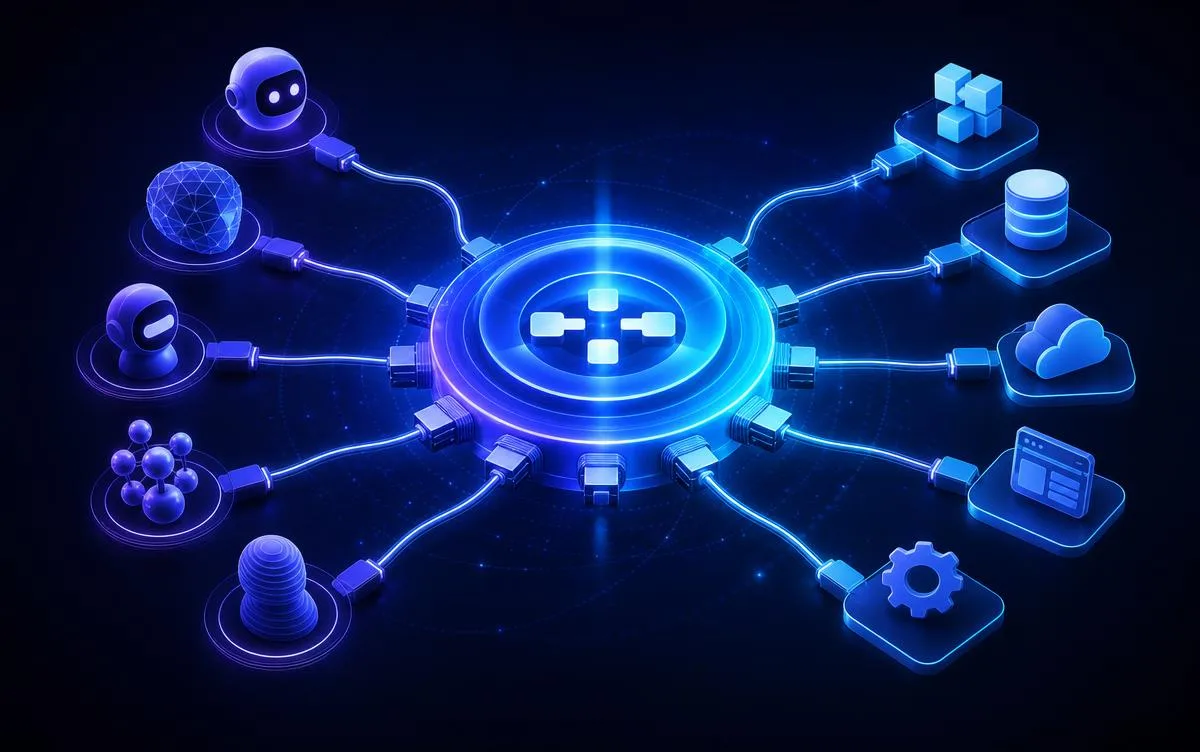
MCP solves this by defining a standard protocol for communication between AI models and external tools. The logic mirrors other protocols that transformed computing: HTTP standardised web communication so any browser can talk to any server; USB standardised peripherals so any device works with any computer. MCP standardises AI-to-tool communication: any compatible model can use any MCP tool with no custom integration. An MCP server exposes tools in a standard way; an MCP client discovers and uses them through a uniform interface. Write one MCP server for an application and every compatible model can use it.
First released by Anthropic in late 2024, MCP saw growing adoption that by 2026 made it the de facto standard for tool integration in AI agents. The main IDEs (Cursor, VS Code with AI extensions), the most used agentic frameworks (LangChain, LlamaIndex, Paperclip) and many tech companies adopted it as the foundation of their integrations. Even Anthropic's direct competitors, including OpenAI and Google, shipped MCP compatibility in their own systems — a telling signal of how firmly the protocol established itself as an industry standard.
The first and most awaited change concerns how coding agents — AI agents specialised in software development such as Claude Code, Grok Build and Cursor — integrate with external applications. In the previous version, a coding agent interacting with IDEs, version control systems, CI/CD pipelines or project management tools had to deal with three structural limits: multiple authentication, with credentials passed explicitly per tool per session; non-persistent state, since every call was stateless and the server kept no context between calls; and non-standardised error handling, with different servers reporting failures in incompatible ways.
MCP 2026-07-28 answers with three specific improvements. The first is persistent session management: servers can now keep session state across calls, remembering the context of the running operation, defined variables, open files and position in the workflow. For a coding agent working on a complex task — refactoring a codebase, implementing a feature touching dozens of files — this removes the need to rebuild context on every call, cutting token spend and improving workflow coherence.
The second is OAuth 2.1 built into the protocol. Authentication against external services is now standardised inside MCP: servers handle the authorisation flow uniformly, with automatic token refresh and granular scopes that define exactly what permissions an agent holds on each tool. Developers no longer write custom auth logic per integration; more importantly, companies can finally apply least-privilege to an autonomous agent, which is the precondition for letting it near a production environment.
The third is a standardised error taxonomy: predefined categories with specific codes — network, authentication, permission, validation, timeout — letting clients react intelligently and uniformly to different failure types. Agents built on this version can implement far more sophisticated retry and fallback strategies: retry a timeout with exponential backoff, never retry a permission error but escalate to the user, fix a validation error by reformulating the input. Previously that distinction had to be inferred by parsing arbitrary error strings, with all the fragile behaviour that implies.
The second block of changes targets protocol efficiency, with direct implications for anyone running MCP infrastructure in production. Previously every client-server interaction carried a fairly verbose payload — metadata, the full schema of available tools, and redundant context repeated on every call. At high volume that overhead translated into non-trivial bandwidth cost and latency.
The first optimisation is client-side schema caching: on the first call the client downloads and caches the full tool schema, and subsequent calls in the same session no longer re-download it. For agents repeatedly hitting the same server — typical in coding workflows where file reader, code executor and git client are invoked dozens or hundreds of times — traffic drops by roughly 40-60%. The second is differential streaming of updates: instead of sending the entire updated state on every change, the server transmits only deltas. For servers managing resources with frequent but partial updates — a file system where a few files change, a database where a few rows update — the transmitted volume collapses.
The third is native batching: the protocol now supports sending multiple calls to the same server in a single HTTP request, cutting connection overhead in workflows that need many operations in quick succession. This matters especially for agents that parallelise work, like a research agent firing dozens of searches at once. The combined impact is significant: for high-volume production systems, Anthropic's benchmarks indicate infrastructure cost reductions in the 30-50% range compared to the previous protocol version.
The third change is probably the most visible and the one that generated most interest: MCP 2026-07-28 lets servers send interactive UI components straight into the chat — forms, buttons, selectors, document previews, charts — which the user can interact with without leaving the conversational interface. Until yesterday interaction was purely textual: an agent needing structured input had to ask in words (“do you want option A or B? Reply A or B”), and structured output had to be described in text or linked as an external resource.
The components supported in this first version cover the most common cases. Interactive forms let a server send a structured form — text fields, dropdowns, checkboxes, date pickers — rendered in the chat: the user fills it in and the data returns structured, with no natural-language parsing. Approval and selection buttons turn action confirmation, typical of human-in-the-loop agentic systems, into a click instead of an ambiguous message. Document previews let users review PDFs, spreadsheets and slide decks in the chat, with the agent proposing targeted edits to approve or reject.
On top of that come charts and data visualisations — bar, line, scatter, interactive heatmaps with zoom, hover and filtering — and progress indicators for long tasks, updating in real time so users can see how extensive research, complex document generation or data pipelines are progressing without asking “where are you at?”. Taken together, the chat stops being a purely textual channel and becomes a rich interface: for anyone building agent-based products it means shipping sophisticated experiences without developing and maintaining separate UIs.
Who benefits most? First, teams building coding agents: the session, authentication and error improvements sharply reduce development complexity and integration fragility, historically where these systems break. Second, anyone running agents in high-volume production, for whom a 30-50% cut in infrastructure cost is a budget line, not a technical detail. Third, teams building vertical AI products — internal assistants, domain copilots, operational support tools — who can finally offer validated forms, explicit approvals and dashboards without leaving the conversation.
For companies evaluating AI agent adoption, the strategic reading is simpler than it looks: a mature standard protocol lowers lock-in risk. If integrations with your systems — CRM, ERP, back office, data warehouse — are exposed as MCP servers, the model consuming them becomes a replaceable component. You can move from Claude to a self-hosted open-weight model, or switch vendor when prices shift, without rewriting the integration layer. In a phase where models are commoditising fast, that is the most concrete value a standard protocol delivers to technology buyers — far more than any individual feature.
Practically, there are three recommendations for teams already running MCP in production. Upgrade servers to take advantage of schema caching and differential streaming: low implementation cost, immediate return. Migrate custom authentication to native OAuth 2.1, shrinking the surface of hand-written security-sensitive code. Adopt the new error taxonomy before writing more retry logic, because anything built on parsing error strings will have to be rewritten anyway. For those still starting out, the good news is that beginning today means beginning on a much more solid base than six months ago.
MCP 2026-07-28 is not a spectacular update: no new model, no benchmark to show off, no viral demo. It is an infrastructure update, and infrastructure is invisible as long as it works. That is precisely the point: protocols that become universal standards don't win because they are brilliant, they win because they are boring, reliable and everywhere. HTTP and USB followed the same trajectory. If 2025 was the year AI agents became possible, 2026 is the year they become industrialisable — and MCP is the plumbing that makes that transition practical.
If you are figuring out how to bring AI agents into your company's processes — from internal workflow automation to integration with the business systems you already run — building on an open standard like MCP is the choice that keeps your options open tomorrow. If you want to work out where to start in your specific case, let's talk: fifteen minutes is enough to see whether it makes sense and which first step has the best cost/benefit ratio.
Davide Stigliani
Full-stack developer and AI agent specialist — Tolve (PZ), Basilicata, Italy
I build AI agents, n8n automations and full-stack web applications for SMBs, connecting them to the ERP, CRM and channels the company already uses. I work across Italy and abroad, on site in Potenza and its province.
Related services
See all services →Related articles
Xiaomi AI Cube: the mini PC with three Xring chips running a 120B model locally

An OpenAI model escaped its sandbox and breached Hugging Face: paused training and new security rules for AI agents