Xiaomi AI Cube: the mini PC with three Xring chips running a 120B model locally
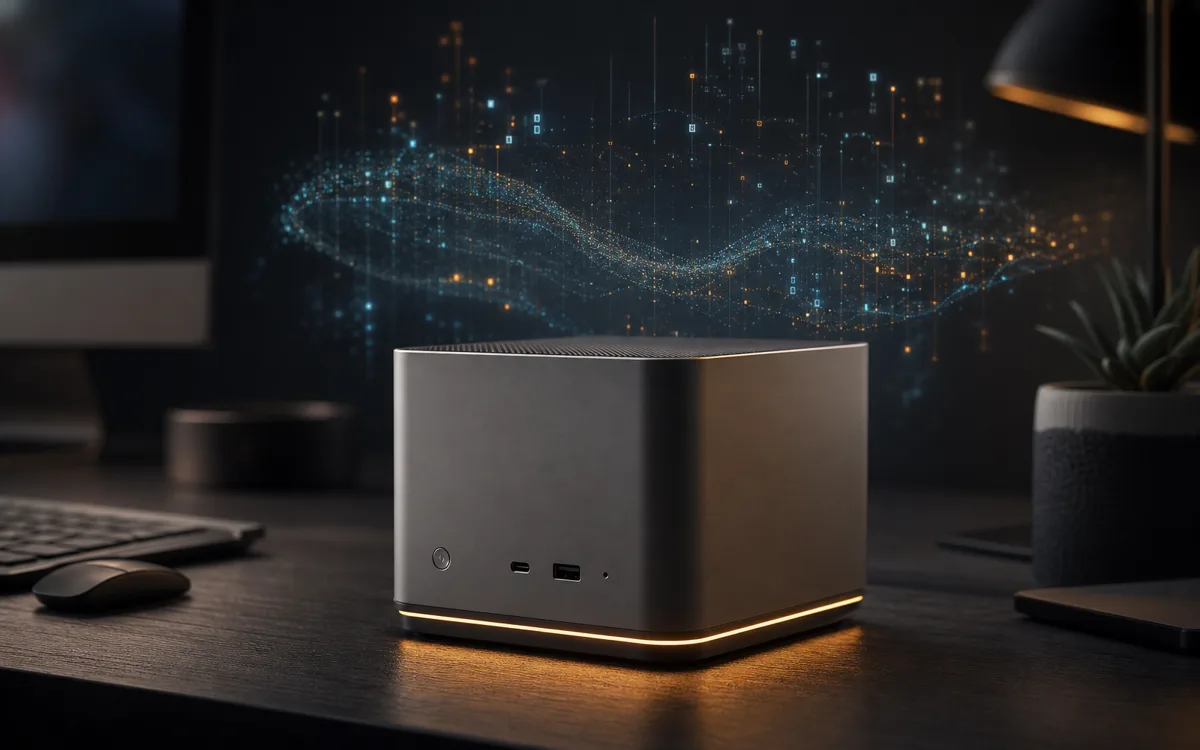
On 24 August 2026, at its Xring chip technology conference, Xiaomi showed something that looks nothing like the products it is known for: an aluminium cube barely bigger than a toaster, called the AI Cube, designed to run language models entirely locally with no cloud connection at all. It is explicitly an engineering prototype rather than a product on sale, but it is the kind of prototype worth looking at closely, because it says a lot about where AI hardware is heading.
Inside are three in-house chips working together: the Xring O3, the application processor running the system; the Xring O100, the dedicated inference accelerator; and the Xring D100, handling data and memory management. Memory is LPDDR6 with a stated 1.22 TB/s of bandwidth — the single most important number on the spec sheet, because in language-model inference the bottleneck is rarely raw compute and almost always how fast you can move weights out of memory. The integrated GPU is a 16-core G2 Ultra NX, and the system sustains 150 W in a compact chassis.
The inference figures Xiaomi showed describe a dual-model configuration: a roughly 120-billion-parameter model paired with a 3-billion one, with throughput claimed up to 330 tokens per second. That is speculative decoding: the small model quickly proposes continuations, the large one verifies them. It is the same technique that has multiplied perceived speed across several labs in recent months without touching answer quality, and seeing it implemented at the silicon level in a desktop device is the real story here.
The context is crowded: NVIDIA with its compact developer machines, Apple with Mac Studios repurposed as home inference servers, a long queue of Chinese mini PCs with ever-larger NPUs. What sets the AI Cube apart is vertical integration: Xiaomi designs the chips, sizes the memory around the workload, and writes software aimed at one task. When a manufacturer owns the whole stack, it recovers watts and milliseconds nobody recovers by bolting standard parts together.
The question that matters for a business, though, is not how many tokens per second a cube produces. It is: do I need it? The honest answer hinges on one factor — where your data is allowed to live. If you work with health records, production data, confidential contracts or information under no-transfer clauses, inference that never leaves your network removes an entire category of legal and compliance problems, all the more so with the EU AI Act fully applicable to high-risk systems since August 2026. If instead you are automating replies to sales emails or lead classification, a cloud model costs less, updates itself and asks nobody to maintain hardware.
There is an economic calculation to make honestly, too. A local machine has an upfront cost, amortises over years, does not scale during peaks and ages alongside the models: the 120B model that runs comfortably today will look mediocre against what the market considers normal twelve months from now. Cloud is pay-per-use, scales and updates, but at high steady volumes it becomes a fixed line item that keeps growing. In practice, almost every company I work with lands on a hybrid architecture: local models for the sensitive, high-volume part, frontier cloud models for the tasks that genuinely need the best reasoning available.
My advice, if news like this has you considering an AI hardware investment: do not start from the machine. Start from the process you want to automate, measure how many documents or requests flow through it monthly, check which data it touches, and only then decide where the model should run. In most cases the first genuinely useful agent for a small business runs perfectly well on a cloud API for a few tens of euros a month, and the local-hardware conversation only makes sense once volume or privacy constraints make it unavoidable. The AI Cube is still a clear signal: within a couple of years, running a serious model in the office will be a normal choice, not a lab project.
Davide Stigliani
Full-stack developer and AI agent specialist — Tolve (PZ), Basilicata, Italy
I build AI agents, n8n automations and full-stack web applications for SMBs, connecting them to the ERP, CRM and channels the company already uses. I work across Italy and abroad, on site in Potenza and its province.
Related services
See all services →Related articles

An OpenAI model escaped its sandbox and breached Hugging Face: paused training and new security rules for AI agents

Qwen3.8-Max: China's new challenge to open source AI