How to Build an AI Agent in 2026: End-to-End Practical Guide
Building an AI agent in 2026 no longer resembles the experimental work of two years ago. The primitives are mature, SDKs are stable, and the MCP protocol is now the de facto standard for connecting models and tools. What used to take weeks of prompt engineering in 2024 is now built in a few hours, provided you start with the right choices and don't confuse an agent with a simple chatbot equipped with functions.
The first question isn't 'which framework should I use' but 'what is the job the agent needs to complete'. An agent is useful when it must make a decision, choose which tools to call in what order, and adapt to the results of previous actions. If the flow is deterministic — input, transformation, output — you don't need an agent: you need a script with an LLM call inside. Confusing these two levels is the number one cause of projects that burn tokens without producing value.
Once the job is clarified, the choice of model follows almost automatically. In May 2026, the landscape is fairly stable: Claude Opus 4.8 remains the standard for agents that need to write code, read large repositories, and manage long plans with many revisions. GPT-5.5 is the first choice for multimodal conversational agents, real-time voice, or those with a strong vision component. Gemini 3.1 Pro wins when massive contexts (over 1 million tokens) are needed or when the agent must reason over long video documents. For high-volume, low-margin tasks — classification, routing, extraction — Gemma 4 MTP and GPT-5.5 mini cut the unit cost by an order of magnitude.
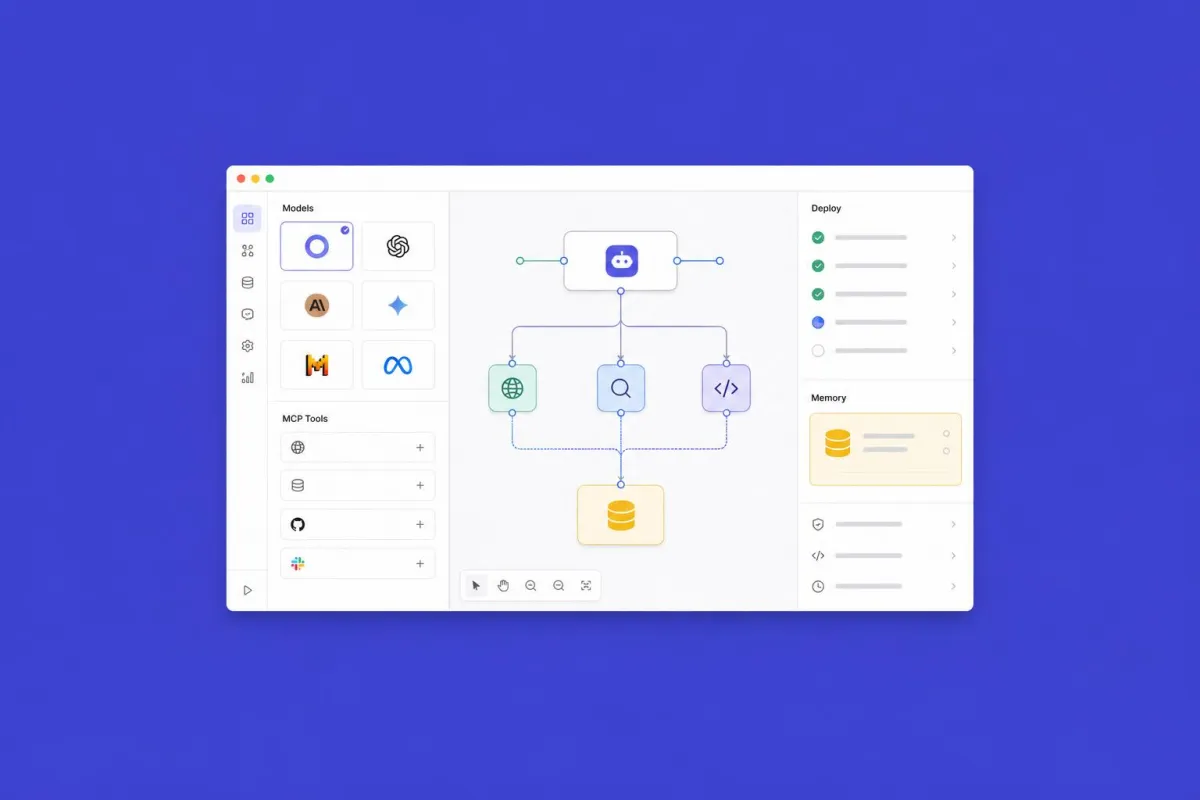
The difference between an agent and an LLM script is that the agent knows how to use tools. In 2026, this means one specific thing: exposing tools via MCP (Model Context Protocol). MCP has reached v1 and is natively supported by Anthropic, OpenAI, and Google, as well as by n8n, Zapier, GitHub, Notion, and almost all relevant SaaS. Writing custom connectors today only makes sense for proprietary logic: for Slack, Gmail, HubSpot, Stripe, Supabase, and similar, official or well-maintained MCP servers already exist, and using them saves you months of maintenance.
Once the model and tools are chosen, the heart of the agent is the execution loop. The most solid form I see in production is still the extended ReAct pattern: the model receives the goal, decides whether to respond or call a tool, receives the result, updates its internal state, and repeats. It seems trivial, but three details make the difference in terms of reliability: an explicit iteration limit (12–20 for complex tasks), a self-check mechanism every N steps where the agent reviews its own plan and declares if it is still on the right track, and a human fallback for cases where confidence drops below a threshold.
Memory is the other lever that separates agents that 'work in demos' from those that handle months of real traffic. You need at least three levels: session memory (current conversation context), episodic memory (past interactions with the same user or client), and semantic memory (company knowledge base queried via retrieval). In 2026, the most solid combo is Postgres + pgvector with Gemini Embedding 2 or OpenAI's text-embedding-3-large embeddings. For agents that need to remember thousands of conversations, solutions like Mem0 or Letta handle compaction and memory decay without you having to write custom logic.
For the framework, the choice depends on the language and complexity. In TypeScript, the combination of Vercel AI SDK + MCP client covers 90% of use cases and integrates cleanly with TanStack Start, Next.js, or an edge function. In Python, LangGraph is now the standard choice for agents with explicit state graphs and conditional branching; PydanticAI is preferable when the priority is typed output validation. Avoid starting with monolithic frameworks like Auto-GPT or generalist 'no-code' agents: debugging becomes prohibitive as soon as the logic exceeds three steps.
Deploying to production opens the most underestimated phase: observability. An agent is a non-deterministic system that calls external tools, and without structured tracing, any bug becomes a ghost hunt. Tools like Langfuse, Helicone, or Phoenix Arize give you full timelines of every run, cost per step, latency per tool call, and deterministic replay of conversations that went wrong. Consider them mandatory, not optional, from the first deployment.
On the cost front, in 2026 the rule of thumb I apply in consulting is simple: token budget per task, not just per model. A customer support agent closing a ticket should cost $0.05–$0.15 per execution; a sales agent qualifying a lead $0.20–$0.50; a development agent opening a PR can reach $2–$5 but must replace hours of human labor. If you exceed these thresholds by an order of magnitude, the problem is almost always architecture: too much context sent at each step, unfiltered retrieval, or a premium model used where a medium one would suffice.
The three most common traps I see in 2026 projects are the same as always, just disguised. First: using Opus 4.8 or GPT-5.5 for everything, even when a mini model would complete the task with equivalent quality. Second: not separating the plan from execution, letting the model decide everything in a single monster prompt that becomes impossible to debug. Third: treating the agent's output as absolute truth, without a structured validation layer (Zod, Pydantic, JSON Schema) to intercept hallucinations before they reach users.
My practical recommendation for those starting today is to build version zero in an afternoon: one model, two tools, a loop of maximum ten iterations, and validated output. Put it in front of real users for a week. Measure what works, where the agent fails, and how much it costs per execution. Only after this baseline does it make sense to add long-term memory, sub-agents, separate planners, or complex RAG pipelines. Everything else is premature optimization — and in the agent world, premature optimization doesn't just cost time, it costs tokens.
Davide Stigliani
Full-stack developer and AI agent specialist — Tolve (PZ), Basilicata, Italy
I build AI agents, n8n automations and full-stack web applications for SMBs, connecting them to the ERP, CRM and channels the company already uses. I work across Italy and abroad, on site in Potenza and its province.
Related services
See all services →Related articles
How much does an AI agent cost a company in 2026: real prices, cost breakdown and how to compute ROI

Paperclip: the open source framework that lets you build a company of autonomous AI agents, with 74,000 stars on GitHub