Anthropic Surpasses OpenAI: Valued at Nearly $1 Trillion, It Is the World's Most Valuable AI Startup
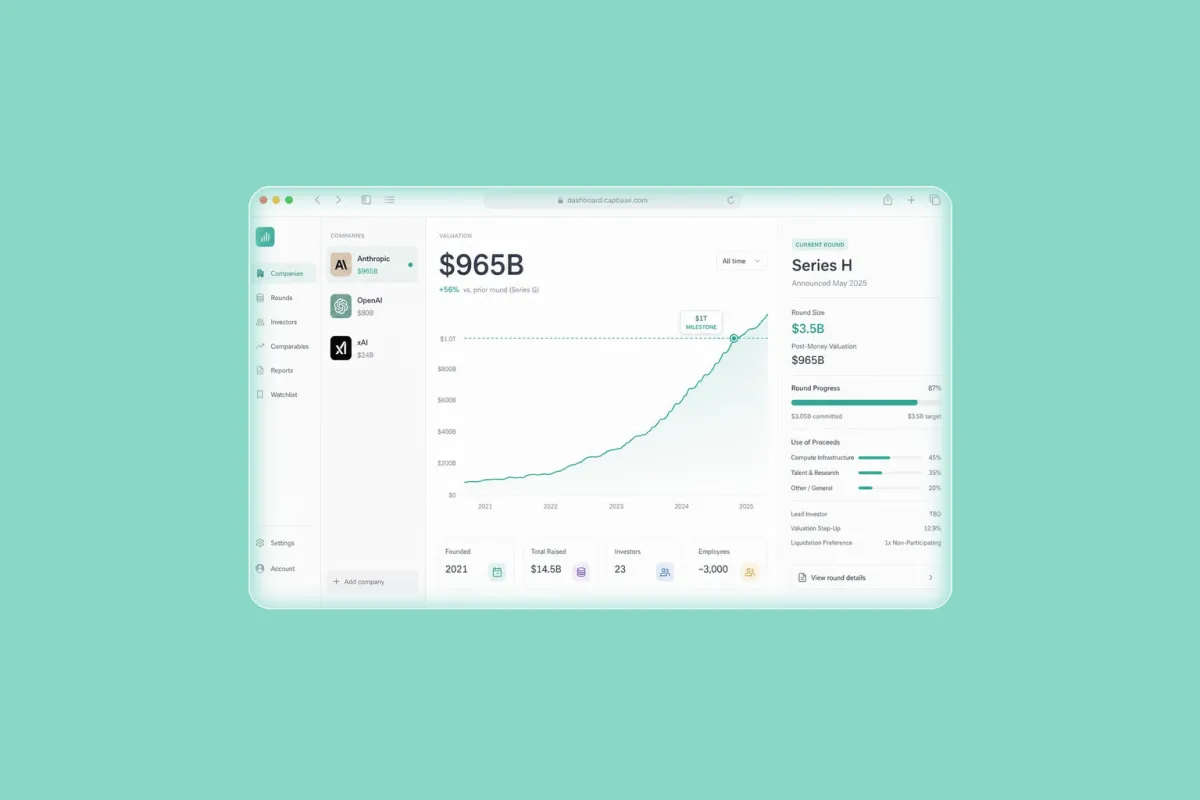
For years, the hierarchy seemed unchangeable: OpenAI at the top, everyone else chasing. On May 28, 2026, that hierarchy was overturned. Anthropic announced a $65 billion Series H funding round, bringing its valuation to $965 billion — officially surpassing OpenAI, which was valued at $730 billion in its last round. In a single day, Anthropic became the most valuable AI startup in the world. And likely the most valuable startup in human history.
The $65 billion round was led by some of the most prominent names in global venture capital: Sequoia Capital, Altimeter Capital, and Dragoneer Investment Group among the principals. The $965 billion post-money valuation represents a nearly two-and-a-half-fold increase from the $380 billion valuation reached just three months earlier in the Series G.
To give a sense of what this number means: Anthropic is now worth more than industrial giants like Toyota, Nestlé, Samsung, and LVMH. It is worth nearly as much as the entire market capitalization of Meta. It is a figure that, until a few years ago, would have seemed impossible for a company founded in 2021 with a handful of former OpenAI employees.
The jump in valuation in three months — from $380 to $965 billion — is likely the fastest value growth in the history of modern capitalism. This is not a speculative bubble without foundations: it is a reflection of a trajectory of operational growth, enterprise adoption, and technological development that markets have recognized as real and sustainable.
The question worth asking is not just 'how much is Anthropic worth,' but 'why is it worth so much right now.' The answer lies not in a single product or announcement, but in a series of moves over the last twelve months that have transformed Anthropic from a research lab into a company with a crystal-clear commercial strategy.
Anthropic has stopped competing on the consumer front — where OpenAI with ChatGPT has a brand and distribution advantage that is hard to close — and has bet everything on the enterprise segment. Claude is now integrated into GitHub Copilot, available on Amazon Bedrock, Google Vertex, and Microsoft Foundry, and adopted by a growing number of large companies as infrastructure for their internal AI systems.
This strategy has a massive competitive advantage: enterprise contracts are multi-year, produce predictable revenue, and generate an ecosystem dependency that is much harder to break than a consumer user's monthly subscription. When a company builds its internal workflows on Claude, the switching cost to a competitor becomes extremely high.
One of the clearest signals of Anthropic's trajectory is who is choosing to work there. Andrej Karpathy — co-founder of OpenAI, former head of AI at Tesla, and likely the most followed AI researcher in the world — announced his move to Anthropic in 2026. Eric Boyd, president of Microsoft Azure AI, did the same. The signal sent by these moves is unmistakable: the people with the best visibility into the industry, and with the best available alternatives, are choosing Anthropic.
Anthropic opened its office in Milan on May 27, 2026 — one day before the mega-round — to support Italian businesses, research, and developers. It is one of six European offices announced in 2026, alongside London, Paris, Berlin, Amsterdam, and Madrid. This accelerated geographic expansion signals that Anthropic is not building an American company with a few European clients. It is building a global company with a local presence in key markets.
Among the reasons fueling the narrative of Anthropic as a technical leader is the existence of a model called Mythos — not yet publicly released — which reportedly demonstrated extraordinary capabilities in identifying critical vulnerabilities in legacy software systems. This is not an academic benchmark. It is about real operational capabilities on real systems, the kind of performance that transforms a language model into a tool with direct implications for cybersecurity and the economic value of the companies that adopt it.
Surpassing OpenAI in valuation is more than just a number. It is a signal that markets are redistributing expectations about who will win the next phase of the AI race — that of deep enterprise adoption, reliable security, and the production of measurable economic value.
OpenAI built the consumer AI market. It brought artificial intelligence into the daily lives of hundreds of millions of people, built the industry's most recognizable brand, and proved that language models have a mass market. This leadership will not disappear overnight.
But the market is starting to price in a scenario where the most important competition is played out not among consumer users, but among large organizations integrating AI into their critical processes — where security, predictability of behavior, technical quality, and customization capabilities matter far more than brand or ease of use. In that segment, Anthropic has built a real and documented advantage.
At a $965 billion valuation, Anthropic is one step away from the trillion-dollar threshold — a territory that no private tech startup in history has ever entered. The question is not if it will get there, but when. With the current round still being finalized and the possibility of an IPO that several analysts consider likely by 2026, the answer could be a matter of weeks or months.
An Anthropic IPO at this valuation would be one of the most significant financial events of the decade. It would bring to the public market a company at the center of the most significant technological transformation in modern history, with a rapidly growing enterprise revenue base and a documented technical lead.
Anthropic's overtaking of OpenAI sends important signals to the entire ecosystem. For companies that must choose which model to adopt as infrastructure for their AI systems, the news reinforces Claude's legitimacy as a safe strategic choice — not a bet on an underdog, but a bet on the currently most valuable company in the sector.
For AI developers and researchers, it is a confirmation that there is space to build massive companies with an approach centered on security and technical quality, not just on release speed and consumer market conquest.
For OpenAI, it is concrete competitive pressure arriving just as the company is trying to complete its transformation into a profit-oriented entity and pursue an IPO amidst enormous expectations.
For everyone else — Google DeepMind, Meta AI, Mistral, xAI — it is confirmation that the market is consolidating around a few players with sufficient technical capabilities, infrastructure, and enterprise market trust to compete. Those who are not among these players today will struggle to enter tomorrow.
Anthropic was founded in 2021 by Dario Amodei, Daniela Amodei, and a dozen colleagues who left OpenAI with the conviction that developing safe and reliable AI required a different approach. Five years later, that conviction is worth nearly a trillion dollars.
This is not just a business story. It is a story about which AI development philosophy the market considers most valuable as the technology transitions from an experiment to critical infrastructure for the global economy. And the market's verdict today is clear: safety, honesty, and technical quality are not a drag on growth. They are exactly what the world is willing to pay the most for.
Davide Stigliani
Full-stack developer and AI agent specialist — Tolve (PZ), Basilicata, Italy
I build AI agents, n8n automations and full-stack web applications for SMBs, connecting them to the ERP, CRM and channels the company already uses. I work across Italy and abroad, on site in Potenza and its province.