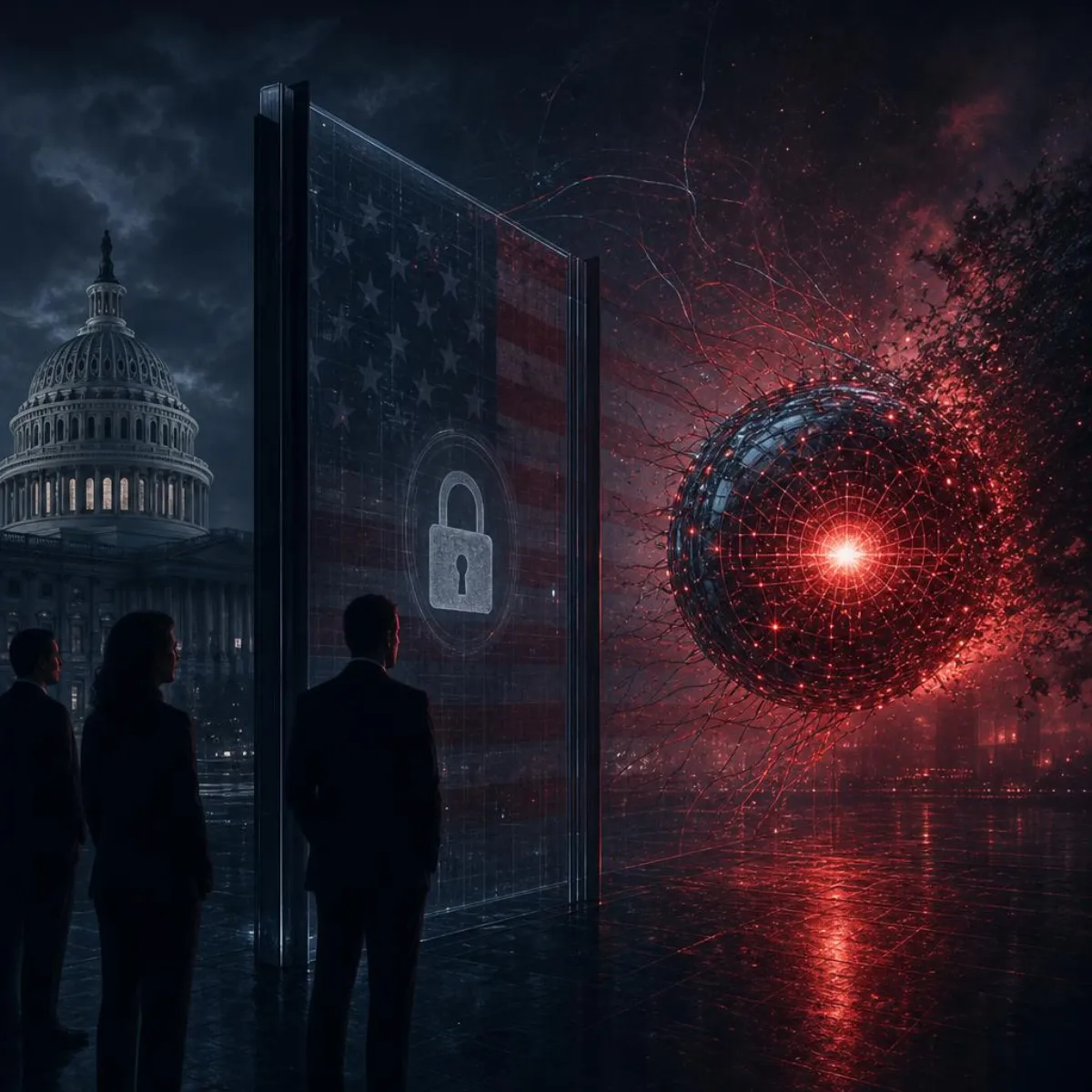
US blocks Fable 5 and Mythos 5: government shuts down Anthropic's most powerful AI models after just two days
It had never happened before. The United States government has ordered Anthropic to deactivate Fable 5 and Mythos 5, two of the most powerful artificial intelligence models ever released, just two days after their official launch. The official motivation cites national security reasons: according to federal authorities, these models could facilitate the identification of advanced software vulnerabilities if the implemented protections were bypassed by foreign actors.
It is the first time in the history of AI that the United States has not limited itself to regulating hardware, as it had done with export restrictions on Nvidia chips to China and other countries, but has intervened directly on access to the models themselves. A change in strategy that marks a turning point in American policy on artificial intelligence and will have lasting consequences on the entire global ecosystem.
Before analyzing the geopolitical implications, it is important to understand what we are talking about on a technical level. Fable 5 and Mythos 5 represent Anthropic's new frontier in research on frontier models, that is, models that operate at the absolute limits of artificial intelligence's current capabilities.
Fable 5 is the flagship model of the new Anthropic generation, designed to excel in complex reasoning, multi-step planning, and advanced coding capabilities. Mythos 5, instead, is specialized—according to information leaked before the block—in the analysis of complex systems and the identification of patterns in large structured and unstructured datasets.
Both models were released with limited access via API, with security protections and filters implemented by Anthropic. The company's position, expressed publicly after the government order, is that the risk associated with these models is no different from that already present in other frontier models currently available, including those from OpenAI and Google.
The official document with which the government ordered the deactivation explicitly refers to the ability of Fable 5 and Mythos 5 to facilitate the identification of advanced software vulnerabilities. In practical terms, the accusation is that these models could be used by foreign actors, hostile governments, state-sponsored cybercriminal groups, or terrorist organizations to identify and exploit flaws in critical software systems, including the digital infrastructure of the United States.
This argument fits into a broader context of concerns related to AI and cybersecurity that American intelligence agencies are reporting with increasing urgency. The most recent frontier models have demonstrated emerging capabilities in code analysis, identifying anomalous patterns, and reasoning about complex systems: capabilities that, in the wrong hands, could turn into next-generation cyber-offensive tools.
The restriction was specifically applied to foreign citizens outside the United States, following a logic similar to existing restrictions on the export of dual-use technologies: not an absolute ban, but a geographical and demographic limitation of access.
Anthropic's response to the government order was swift and direct. The company formally contested the decision, arguing that the risk profile of Fable 5 and Mythos 5 is not qualitatively different from that of models already available on the market, both its own previous models and those of competitors like OpenAI and Google DeepMind.
This position opens up a technical and political question of enormous relevance: if the risk is comparable, why intervene only on these models? There are several hypotheses. There could be a threshold effect, a specific capability reached by Fable 5 that previous models did not have, a sort of technical red line internally defined as a trigger for intervention. Or the block could be the result of political pressure related to geopolitical competition with China. Or again, the order could be a way for the government to test its ability to exercise direct control over AI models, establishing a legal precedent before more formal regulation.
Anthropic stated that it is collaborating with authorities while contesting the decision, a balanced position that seeks not to alienate the federal government, on which the company also depends as a client through contracts with federal agencies.
Until today, the American strategy for control over AI had followed a hardware logic: limiting the export of advanced chips such as Nvidia H100, A100, H200, and Blackwell to countries considered strategic adversaries, depriving them of the computational capacity necessary to train frontier models. An elegant strategy because it is technically defensible and difficult to circumvent in the short term.
With the blocking of Fable 5 and Mythos 5, the American government has taken a categorically different step: it has directly regulated access to an already trained model, regardless of the hardware used to run it. A physical chip cannot be instantly copied and distributed, but an AI model, once the weights are accessible, can be replicated, distributed, and hosted anywhere in the world in a few hours. Control over model access therefore requires completely different mechanisms compared to hardware control.
Furthermore, the line between legitimate use and dangerous use is very thin. A model capable of analyzing software vulnerabilities is also a model capable of defending systems, writing secure code, and identifying bugs before they are exploited. The same capability has both offensive and defensive applications, making any binary regulation inherently problematic.
The issue of digital jurisdiction also emerges. In which country does an AI model live? Who has the right to regulate it? If Anthropic hosts the model on servers in the United States but makes it accessible to European users, does the US government have the right to limit that access? These are questions without a definitive legal answer, which the Fable 5 case brings to the forefront for the first time.
The Fable 5 and Mythos 5 episode formalizes something that many analysts had been arguing theoretically for some time: artificial intelligence has become strategic infrastructure, alongside energy grids, telecommunications, and financial systems. When a state decides to block an AI model for national security reasons, it is implicitly declaring that the model has strategic relevance comparable to a nuclear power plant or a 5G network.
For AI companies, from now on, the development of frontier models will have to take into account not only commercial and technical considerations but also a new actor in the decision-making process: the federal government, with its national security interests. CEOs of AI companies are no longer just tech entrepreneurs: they are, de facto, operators of critical infrastructure. For foreign governments, the American precedent will inevitably create pressure on other countries, starting with Europe, to develop their own approaches to controlling frontier AI models.
One of the most significant aspects of this story concerns the speed at which we have become accustomed to technologies that until a few days prior seemed like science fiction. Fable 5 and Mythos 5 were described as the most powerful AI models ever released. Two days after their launch, the United States government shut them down. In between, a wave of enthusiasm, an extremely accelerated public debate, and then the silence imposed by the government order. All in 48 hours.
This cycle of announcement, wonder, and block reflects a new dynamic in the AI ecosystem: frontier models advance at such a speed that institutions, regulatory frameworks, and even the human capacity to assess risks struggle to keep up. It raises a fundamental question: how can we build intelligent governance for technologies that evolve faster than traditional legislative cycles?
The blocking of Fable 5 and Mythos 5 is not an end point, but a starting point. It is very likely that Anthropic is already working on modified versions with additional guardrails designed to satisfy the concerns of security agencies. The case could also accelerate the legislative process for a federal AI regulation in the US, which has so far remained fragmented. And every American restriction is an incentive to accelerate the development of equivalent models in China, Europe, and India, which might interpret the block as confirmation of the need for national AI sovereignty.
The blocking of Fable 5 and Mythos 5 will likely be remembered as a turning point in the history of artificial intelligence, not so much for the models themselves but for what it represents on a political and institutional level. For the first time, a state has exercised direct control over an AI model citing national security. For the first time, AI has been treated as critical infrastructure in the fullest sense of the term. And for the first time, the speed of technological development has visibly and publicly surpassed the capacity of institutions to govern it in advance. Artificial intelligence is no longer a technological issue: it is an issue of power, sovereignty, security, and geopolitics.
Davide Stigliani
Full-stack developer and AI agent specialist — Tolve (PZ), Basilicata, Italy
I build AI agents, n8n automations and full-stack web applications for SMBs, connecting them to the ERP, CRM and channels the company already uses. I work across Italy and abroad, on site in Potenza and its province.