Fugu by Sakana AI: Japan didn't build a bigger AI, it built one that conducts all the others
In the 2026 AI debate the dominant narrative is always the same: bigger models, more parameters, more data, more compute. The frontier-model arms race follows a linear logic: whoever has the most powerful model wins. But from Japan comes an idea that challenges this narrative at its roots, and does so with disarming conceptual simplicity.
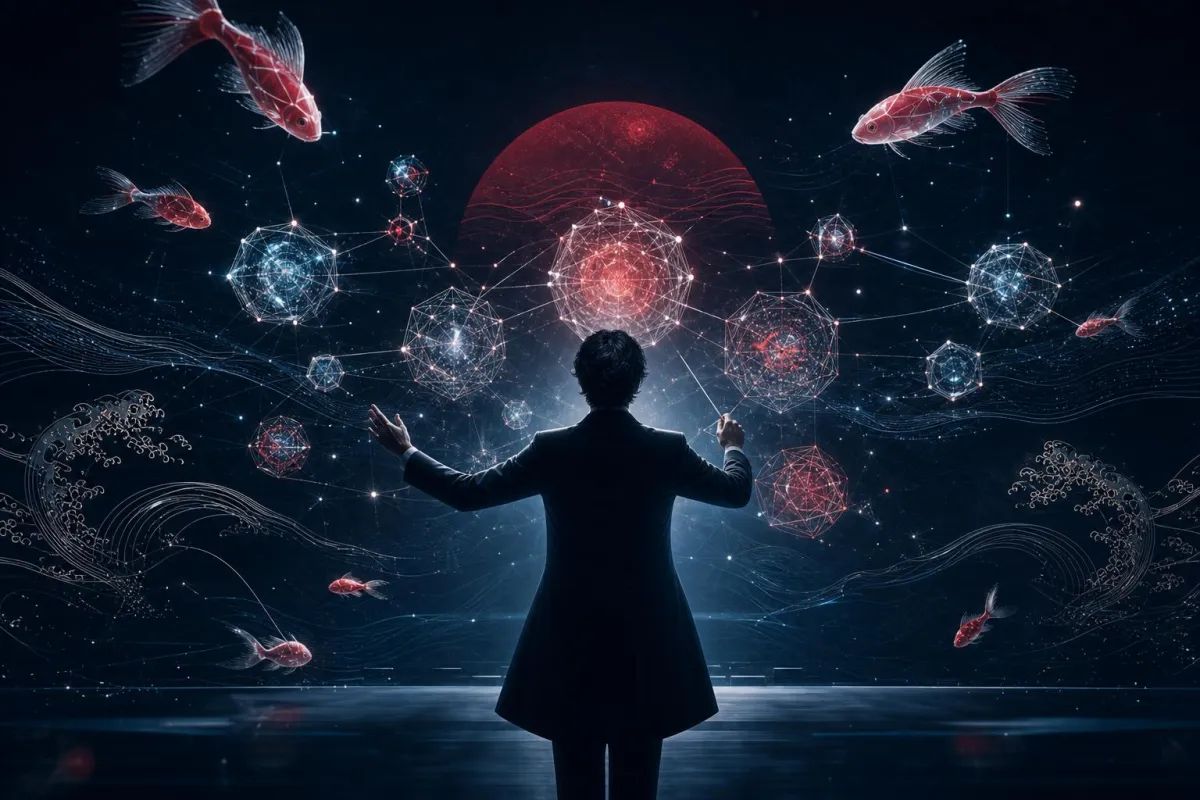
Fugu, developed by Sakana AI, the lab founded in Tokyo by David Ha and Llion Jones, two former Google DeepMind researchers, is not a bigger model. It is a system that coordinates all the others. A conductor who does not play alone, but makes every single musician in the ensemble play better, and the resulting orchestra surpasses any soloist, however talented.
The practical result is striking: Fugu, using only the models at its disposal, without access to Claude Mythos and Fable blocked by American restrictions, reaches performance levels comparable to the most advanced frontier models in the world. Not because it has more parameters, but because it orchestrates better.
Before diving into Fugu's technical details, it is worth understanding who is behind this project. Sakana AI is an atypical lab in the global AI landscape, founded in Tokyo in 2023 by David Ha, former Head of Research at Google Brain, and Llion Jones, one of the original co-authors of the Attention Is All You Need paper that gave birth to the transformer architecture.
The name Sakana means fish in Japanese, an explicit reference to the biology of fish schools, where complex collective behaviors emerge from the interaction of simple individuals without centralized control. It is a perfect metaphor for the philosophy guiding the lab's research: intelligence emerging from collaboration, not from the size of a single agent.
Sakana AI has built its reputation by publishing original research on nature-inspired artificial intelligence, evolutionary algorithms, multi-agent systems, collaborative learning. Fugu is the most ambitious synthesis of this philosophy applied to the concrete problem of maximizing AI performance without indefinitely scaling individual models.
The conductor metaphor best captures Fugu's essence. Every AI model has strengths and weaknesses. GPT-5 excels at general reasoning but can be outperformed by models specialized in math or coding. Claude is particularly strong in ethical reasoning and writing but can be beaten by other models on specific technical tasks. Traditionally the solution was to train an even bigger unified model, hoping that scale would compensate for the weaknesses of each individual domain.
Fugu takes a radically different approach: instead of creating a single all-encompassing model, it creates a meta-system that understands which model is best suited for which part of the problem, coordinates them intelligently, and synthesizes their answers into a unified output of superior quality.
When a user asks Fugu a question, the system does not simply pass it to the best model statically. The process is much more sophisticated. First, Fugu decomposes the request into its fundamental components, logical reasoning, factual knowledge, creativity, coding, mathematical analysis, context understanding, evaluating which dimensions are most relevant to the specific task. Based on the analysis it then selects the optimal subset of models to involve, not always all of them, but those most suited to the specific components of the problem.
The selected models work in parallel on specific subproblems or on the full problem, generating independent responses that Fugu collects and compares. Fugu does not simply pick the best response, it synthesizes them, integrates the most valuable contributions of each model, resolves contradictions, and produces a unified output that exceeds the quality of any individual response. The system learns from experience, refining over time its routing and synthesis capabilities based on the feedback it receives.
What is most striking about Fugu is not the mechanism itself: the idea of model ensembles is not new in AI research. What surprises is the magnitude of the improvement over the individual components. In tests conducted by Sakana AI, the models that Fugu coordinates individually obtain a certain score on standardized benchmarks. When orchestrated by Fugu, the overall score of the system surpasses that of each component taken individually, and not by a little. The orchestra plays better than the individual musicians, even the best ones.
This result has a deep intuitive explanation: reality is complex, and hard problems almost always have multiple components. A math problem requires formal reasoning but also text comprehension. A business strategy question requires domain knowledge but also creativity and synthesis. A system that can mobilize the best specific capabilities for each component of the problem will be systematically more performant than a system using a single generalist approach.
The detail that most captured the global AI community's attention is this: Sakana AI does not have access to Claude Mythos and Claude Fable, Anthropic's models blocked by the US government under export restrictions. Yet, in its own tests, Fugu reaches performance levels comparable to these frontier models using exclusively the models it has at its disposal.
If an intelligent orchestration system can achieve the performance of a single top model without using that model, then the competitive value of the most advanced frontier models drops significantly. The competitive moat is no longer having the biggest model but having the most intelligent orchestration system.
From the standpoint of AI geopolitics, Fugu's result is another signal, after GLM 5.2 and the Chinese models, that the American control strategy based on restricting access to specific frontier models is structurally weak. If it is possible to replicate the performance of those models through intelligent orchestration of smaller models, the block loses most of its practical meaning.
Perhaps the most important message is this: in 2026 AI innovation is not measured only in billions of parameters. A relatively small lab, with a brilliant architectural idea and rigorous execution capability, can compete with the Silicon Valley giants that spend billions to train ever-larger models.
It is important to be honest about an aspect that the most attentive observers have raised: the tests showing Fugu at the level of the models blocked by Anthropic were conducted by Sakana itself, not by independent bodies. Comparing a multi-model system with a single model is not a perfectly symmetric comparison. Fugu, by definition, uses more computational resources than a single model, more API calls, more potential latency, higher operating costs. A win in output quality could conceal a significantly larger computational cost.
These are not reasons to downplay the result, but they are variables to keep in mind when evaluating Fugu's practical impact in real scenarios. Independent validations will be needed to precisely quantify the system's real advantage over its components and over competing frontier models.
Beyond the specific numbers, Fugu introduces a deep conceptual challenge to the dominant narrative in AI development over the last few years. For years the rule was simple: bigger is better. More parameters, more training data, more compute during training, these were the main levers of AI innovation, and empirical results seemed to confirm it almost universally, the OpenAI and DeepMind scaling laws.
Fugu says something different: smarter is better. You do not necessarily need a bigger model if you can orchestrate the existing ones more intelligently. The size of the brain matters less than the quality of the connections and the coordination capability. This is exactly the logic that governs the most sophisticated biological systems. The human brain is not simply the largest among mammalian brains, it is the one with the most complex and sophisticated architecture of connections. A single ant is a simple insect, but an ant colony solves optimization problems that challenge the best computational algorithms. Intelligence emerges from coordination, not from size.
For companies building AI-based products and processes, the direction indicated by Fugu has immediate practical implications. It is not enough to pick the best AI model and use it for everything. Companies that learn to build intelligent multi-model orchestration systems, dynamically adapting which model to use for which task, will have a structural competitive advantage over those using a monolithic approach.
Having access to multiple different models is not necessarily a management problem, it can be a resource, if you have the right tools to orchestrate them. Fugu demonstrates that portfolio diversity can be a source of competitive advantage. In a multi-model system, intelligently managing which model to call for which task is not just a question of output quality, it is also a question of cost optimization. An efficient orchestration system can balance quality and cost much more granularly than a single-model approach.
The main practical limitation of multi-model systems like Fugu is latency: calling multiple models in parallel or in sequence is structurally slower than calling just one. For real-time applications this is a critical variable that system designers must carefully consider.
Fugu is not an isolated project, it is the embodiment of a broader vision that Sakana AI is systematically building. David Ha has spoken publicly about a future in which AI systems will not be centralized monoliths but distributed ecosystems of specialized agents that collaborate, specialize, and evolve dynamically. In this vision the value does not lie in the single most powerful model, but in the orchestration capability, in the intelligence that knows how to put together the right parts at the right time, coordinate the responses, resolve conflicts, and produce outputs superior to the sum of the individual contributions.
It is a deeply Japanese vision, in a sense, inspired by the philosophy of kaizen, continuous improvement through small coordinated steps, and by the Japanese manufacturing tradition where excellence emerges from sophisticated systemic processes rather than from isolated geniuses. And perhaps this is exactly the point: the future of AI does not belong only to those who have the biggest model. It belongs to those who know how to make all the others play together.
Fugu by Sakana AI is much more than an interesting technical result. It is a manifesto on how the entire architecture of artificial intelligence could evolve in the coming years. If the paradigm of the single all-encompassing model has dominated the past decade, the emerging paradigm could be that of intelligent orchestration of specialists, systems that do not try to know everything, but always know whom to ask and how to integrate the answers.
In a world where frontier models are blocked by governments, where the computational costs of training ever-larger models grow exponentially, and where model specialization produces results superior to forced generalization, Fugu's logic has a growing appeal, technical, economic, and geopolitical. Japan did not build a bigger AI. It built one that conducts all the others, and perhaps this is precisely the most important lesson of 2026.
Davide Stigliani
Full-stack developer and AI agent specialist — Tolve (PZ), Basilicata, Italy
I build AI agents, n8n automations and full-stack web applications for SMBs, connecting them to the ERP, CRM and channels the company already uses. I work across Italy and abroad, on site in Potenza and its province.
Related services
See all services →Related articles
GLM 5.2: the Chinese model that beats Claude Fable and rewrites the global AI hierarchy

Kimi K2.7 and Minimax M3: while the US blocks Mythos 5, China advances at an impressive speed