TimesFM-3: Google's open source model that forecasts your company's numbers
Every business owner makes forecasts, even those who never call them that
How much will I sell next quarter, how much stock should I order before Christmas, will cash cover salaries and suppliers at the end of the month, do I need one more person on the line or will current shifts do. Until yesterday these answers came out of a spreadsheet, the owner's experience, or — in the worst case — gut feeling. Google has just released TimesFM-3, the third generation of its open source forecasting model, and it is a step change: a model trained on enormous amounts of time-series data that takes your company's past numbers and tells you, with a measurable margin of error, what is likely to happen next.
What it is, in plain terms
TimesFM is a foundation model for time series: just as a language model was trained on millions of texts and knows how to complete a sentence, TimesFM was trained on billions of historical data points — sales, web traffic, energy consumption, prices — and knows how to extend a series of numbers into the future. Version 3 introduces two capabilities that change everything for businesses. The first is multivariate forecasting: the model doesn't only look at the series you want to predict, but also at related variables. Not just how much you sold, but how much you sold in relation to price, promotions, seasonality, site traffic and weather. The second is that it doesn't need training on your data to produce useful results: it works zero-shot — you hand it the history and it forecasts. In the benchmarks published by Google on the field's reference datasets, TimesFM-3 comes out more accurate than its main open source and proprietary competitors — with the obvious caveat that these are Google's benchmarks and should be verified on your own case, which any serious project does anyway during the pilot phase.
The practical difference from the classic method is substantial
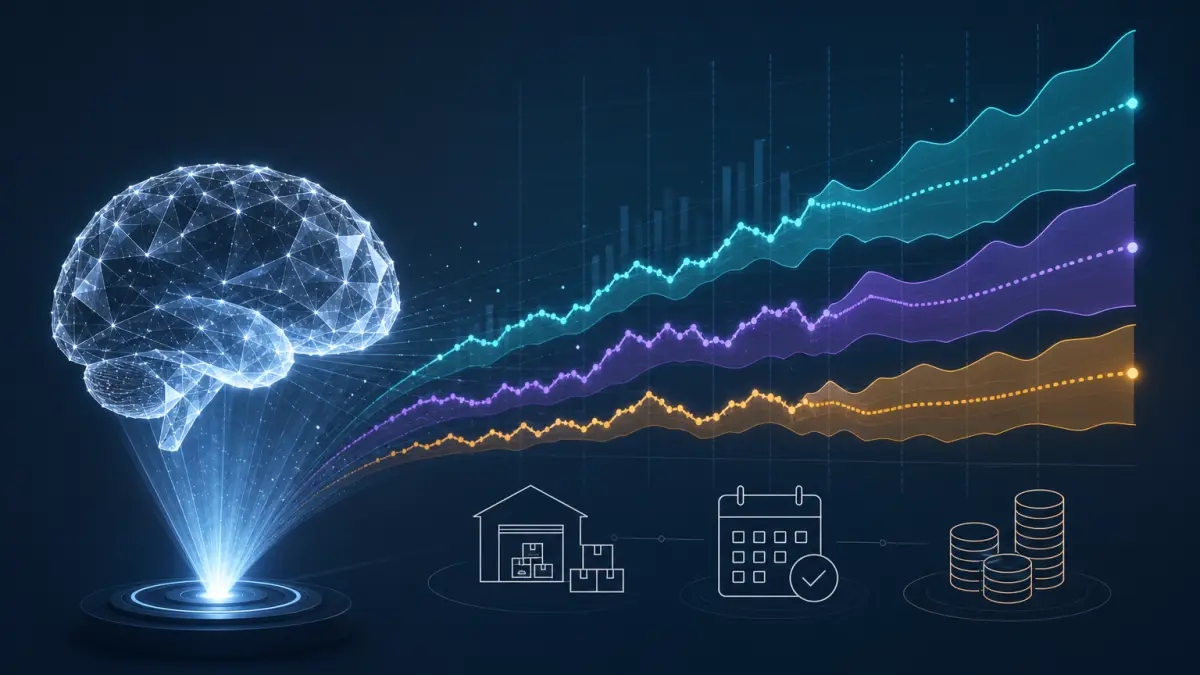
A hand-made forecast usually considers one variable at a time: last October I sold X, so this year I'll sell X plus a bit. TimesFM-3 instead cross-references series: if October sales depend on September site traffic, active promotions and temperature — as genuinely happens in many sectors — the model uses all of these series together and produces a forecast with a confidence interval: not a bare number, but a range with optimistic, central and pessimistic scenarios. For someone deciding how much to order, that range is worth more than the number.
What it can forecast, concretely, in an Italian SMB
Sales by product, customer and area, week by week: whoever sells to recurring trade customers knows in advance which items to order from the wholesaler and in what quantity. Inventory: crossing forecast sales with reorder lead times, the system flags early which SKUs will run short and which will sit still consuming capital. Liquidity: combining forecast revenue with the receivables and payables calendar, an eight-to-twelve-week cash forecast that would normally require a part-time controller. Staffing: in sectors with seasonal peaks, forecasting the workload week by week to size shifts and reinforcements. And purchase prices: if you buy raw materials or energy, having a scenario on commodity prices helps you decide when to hedge.
Why being open source matters more than it seems
An open source model runs wherever you want: on your server, on a European cloud, on a machine under your desk. Sales, customer and margin data never have to leave the company — for many SMBs this alone decides whether a project happens or not. There are no licence fees or per-forecast subscriptions: you only pay for the infrastructure it runs on, and a forecasting model is no power monster — at SMB volumes it runs on modest hardware. And above all, no vendor lock-in: the model is yours, the results are yours, and if something better comes out tomorrow you swap it without migrating off a service.
How it integrates with the systems you already have
TimesFM-3 is not software with an interface: it's a model, and it needs to be placed inside a pipeline. The typical architecture I build has three parts. First, data collection: historical series come out of the ERP, the e-commerce platform, the sales spreadsheet or the database, through an integration we usually orchestrate in n8n. Second, the model itself, running on a small server and producing forecasts at a regular cadence — weekly for sales and inventory, daily for cash. Third is where forecasts become decisions: a report arriving every Monday morning, a dashboard, an automatic alert when the cash forecast dips below a threshold, or the direct update of minimum stock levels in the ERP. Forecasting is the brain; automation is the body that makes it useful.
Where it doesn't help, and it should be said clearly
If you have less than two years of orderly history, the model has little to learn from: the data needs fixing first. If your business is a few large contracts a year — three deals worth three hundred thousand each — no time series will help: the forecast lives in the customer relationship. If sales hinge on non-recurring events — a public tender, a trade fair, a one-off campaign — the model predicts the baseline well and the peaks poorly. And if today you don't decide anything based on numbers — you order by instinct and it works fine — a better forecast won't change the outcome: the decision process changes first, the model comes after.
On costs, to be concrete
The model is free: it's open source under a permissive licence. The server it runs on, at SMB volumes, costs between 15 and 50 euros a month. The real cost is the project: connecting the data sources, cleaning the history, validating the forecasts against past months — it's called backtesting, and it's the step that separates a reliable tool from an oracle — and putting reports and alerts into production. A project on a single series, say total sales, typically lands between 3,000 and 6,000 euros; a system forecasting sales by product line, inventory and cash with ERP integration rises to 8,000-15,000 euros. The return comes from three measurable sources: less capital locked in inventory, fewer stockouts on fast-moving products, fewer liquidity surprises.
The right way to start is not buying anything: it's the backtest. Take the company's historical data, ask the model to forecast the last six months pretending not to know them, and compare the forecasts with what actually happened. If the error is lower than your current method — spreadsheet, instinct, moving average — the project is worth it and you already know by how much. If it isn't, you found out by paying for an analysis instead of a project. It's a calculation that takes a few days, and no serious vendor should sell you a forecasting system without showing it to you first.
If you want to know what TimesFM-3 could forecast on your company's numbers, in a fifteen-minute call we look together at the history you have, which decisions you make by instinct today, and I'll tell you whether a backtest makes sense — and if it doesn't, I'll explain what to fix first.
Frequently asked questions
How much history does TimesFM-3 need?
At least two years at a consistent granularity (daily or weekly). Below that, forecasts stay unstable and it is better to fix data collection first.
Does my data leave the company?
No, if the model runs locally or on your own server: being open source, business data stays inside your perimeter. That is the main reason it is chosen over cloud forecasting services.
How do I know it works for my business?
With a backtest: feed history up to a year ago, compare forecasts against what actually happened and measure the error before investing in integration.
Davide Stigliani
Full-stack developer and AI agent specialist — Tolve (PZ), Basilicata, Italy
I build AI agents, n8n automations and full-stack web applications for SMBs, connecting them to the ERP, CRM and channels the company already uses. I work across Italy and abroad, on site in Potenza and its province.