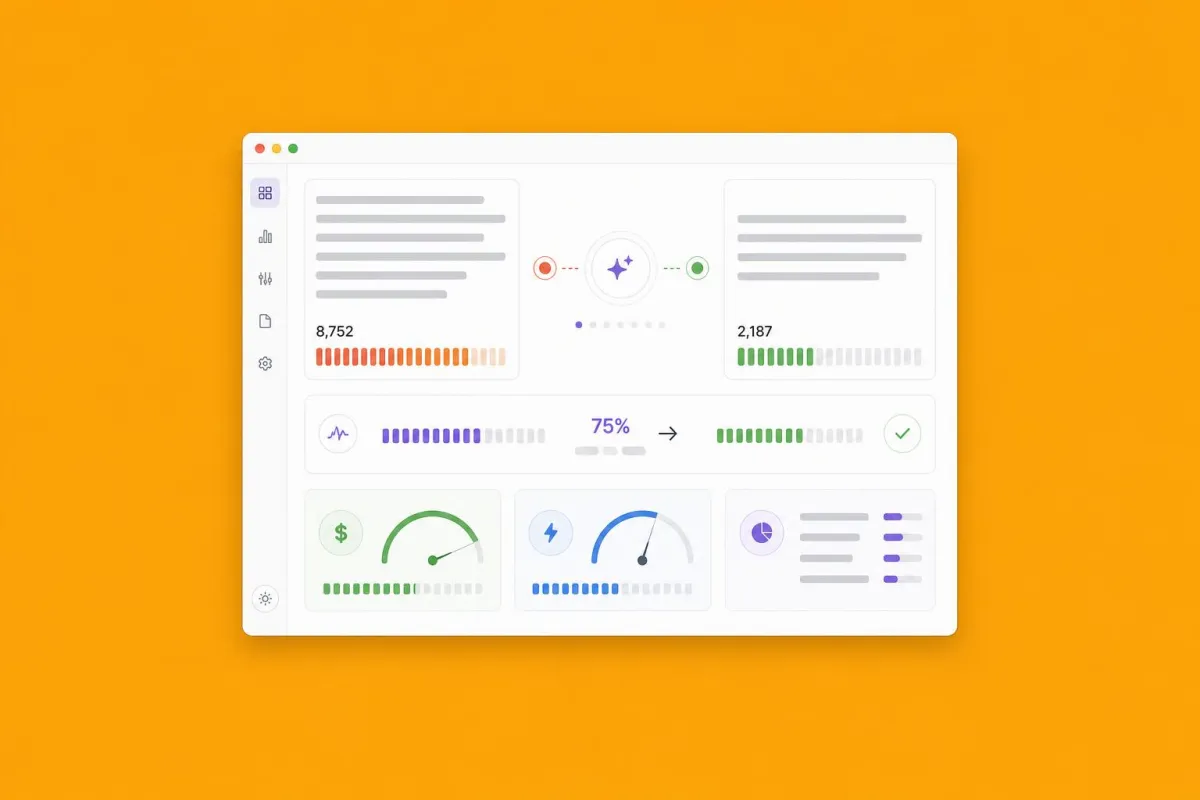
Save 75% of tokens and make AI 3x faster
Optimizing token usage is not just a matter of cost — even if costs matter, especially when scaling. It is first and foremost a matter of speed, user-perceived latency, and architecture. Fewer tokens processed means faster responses, cheaper inferences, and systems that hold up better under load.
The technique for drastically reducing the number of tokens without losing quality is based on an obvious but often overlooked principle: redundancy in context. Many AI systems send a much larger amount of information to the model than is actually needed. Redundant instructions, entire documents when specific sections would suffice, multiple examples when a single one would be enough.
The operational skill lies in learning how to build surgical prompts and contexts: every token must earn its place. This requires understanding how the model uses context, which parts of the input truly influence the output, and which are ignored or produce noise.
The gain is measurable: a 75% reduction in tokens translates into three times lower latency and proportional costs. For a production application with thousands of daily users, this completely changes the economic sustainability of the service. For a prototype, it allows for much more testing with the same budget.
Davide Stigliani
Full-stack developer and AI agent specialist — Tolve (PZ), Basilicata, Italy
I build AI agents, n8n automations and full-stack web applications for SMBs, connecting them to the ERP, CRM and channels the company already uses. I work across Italy and abroad, on site in Potenza and its province.