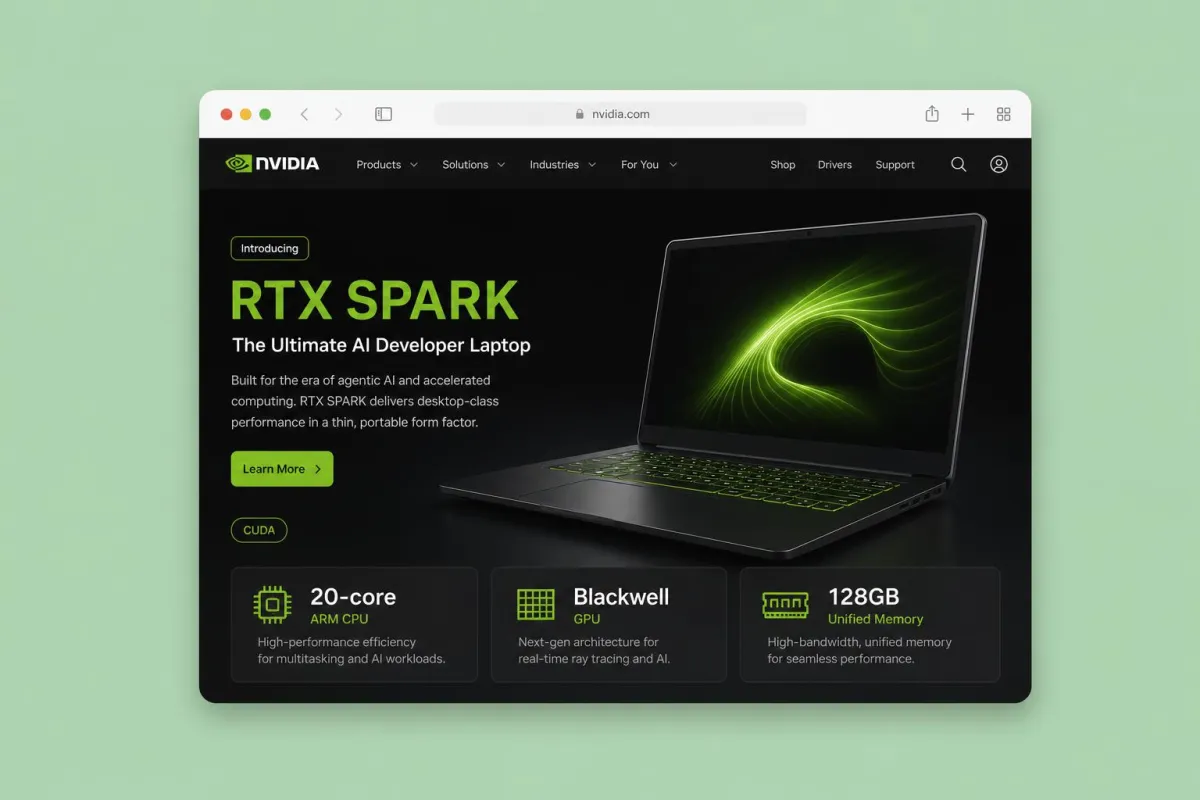
NVIDIA's Great PC Gamble: Is RTX Spark a Real Revolution or a Gilded Cage?
For years, we have witnessed NVIDIA's unchecked dominance in the data center sector. Jensen Huang has transformed a gaming graphics card company into the undisputed gatekeeper of global AI infrastructure. But data centers, however profitable, are closed rooms far from the public eye. Now, NVIDIA has decided it's time to take over your desk.
At GTC Taipei, Huang played his ace: RTX Spark, the first NVIDIA processor designed specifically for Windows laptops and desktops. We aren't talking about the usual dedicated graphics card to be paired with an Intel or AMD processor. This time, NVIDIA has built the entire engine: a 20-core Arm CPU coupled directly with a Blackwell architecture GPU (with performance estimates close to a desktop RTX 5070) and, most importantly, the entire CUDA software suite integrated into the die.
Huang called it the first PC line to be completely re-engineered in the last 40 years. But behind the keynote proclamations and fanboy enthusiasm, is there a market ready to be conquered, or are we witnessing yet another attempt to impose a software monopoly on consumer hardware?
The real turning point of RTX Spark is not the raw power of the Arm CPU, nor the muscle of the Blackwell graphics. The true game changer—something that no Windows on Arm chip, not even the Qualcomm Snapdragon X, has ever been able to offer until now—is full, native CUDA support.
If you're a developer, you know exactly what that means. CUDA is the de facto standard for training and inference of Artificial Intelligence models. Anyone doing deep learning, local LLMs, or serious AI development today is forced to use Linux or desktop PCs with enormous, power-hungry dedicated GPUs. By bringing CUDA directly into a laptop chip, NVIDIA is redefining the concept of the "AI PC."
Huang's stated goal is to run agentic AI—composed of autonomous agents that plan and execute complex tasks in the background—by default on the operating system, without latency and without depending on the cloud. It is a deadly strategic move: tethering developers and power users to the NVIDIA ecosystem starting right from their laptop's silicon.
However, there is an elephant in the room as large as a data center. NVIDIA claims these new PCs will be able to run "any Windows application ever created." A statement that certainly grabs attention, but one that clashes with a complex technical reality: backward compatibility is based on x86 emulation.
Arm architecture speaks a different language than classic Intel and AMD processors. Translating software instructions on the fly requires resources and, historically, emulation on Windows has always been a partial tragedy in terms of performance and stability. Microsoft and Qualcomm have made giant strides recently, but the actual effectiveness of NVIDIA's translator is still to be proven in the field. If you buy a laptop costing thousands of dollars and your legacy work software or old games stutter or crash due to emulation, the Blackwell architecture on board becomes an expensive paperweight.
Arriving this autumn on devices from major manufacturers—Dell, Microsoft, HP, ASUS, and Lenovo—RTX Spark throws down an unprecedented gauntlet to the entire industry. Intel and AMD see their historic x86 fortress in the PC world threatened by a competitor with virtually unlimited financial resources and total control over the AI narrative.
Qualcomm, which had just found a foothold in Windows Arm laptops, risks being crushed by NVIDIA's graphical and software superiority. Apple, with its M-series chips, is no longer the only one able to offer staggering performance-per-watt on Arm architecture, with the difference that NVIDIA brings with it a gaming and AI development ecosystem that those in Cupertino can only dream of.
NVIDIA is trying to do with PCs what it perfectly achieved with servers: create a closed ecosystem where hardware and software are so interconnected that leaving becomes impossible. If x86 emulation proves robust and Blackwell GPU power consumption remains manageable in a thin chassis, RTX Spark could truly usher in a new era for personal computing.
But as always in tech, between the slides of a Taipei keynote and the daily user experience lies software optimization. And there, shortcuts simply don't work.
Davide Stigliani
Full-stack developer and AI agent specialist — Tolve (PZ), Basilicata, Italy
I build AI agents, n8n automations and full-stack web applications for SMBs, connecting them to the ERP, CRM and channels the company already uses. I work across Italy and abroad, on site in Potenza and its province.