Screen Extinction: Is Programming Without a Laptop the Next Tech Madness (or Genius)?
For decades, the image of the developer has remained unchanged: a person sitting in front of one, two, sometimes three monitors, with fingers glued to a mechanical keyboard. We have witnessed the transition of servers to the cloud and desktop computers to increasingly thin laptops, but the umbilical cord to the physical screen and traditional visual interface has never been cut. Until now.
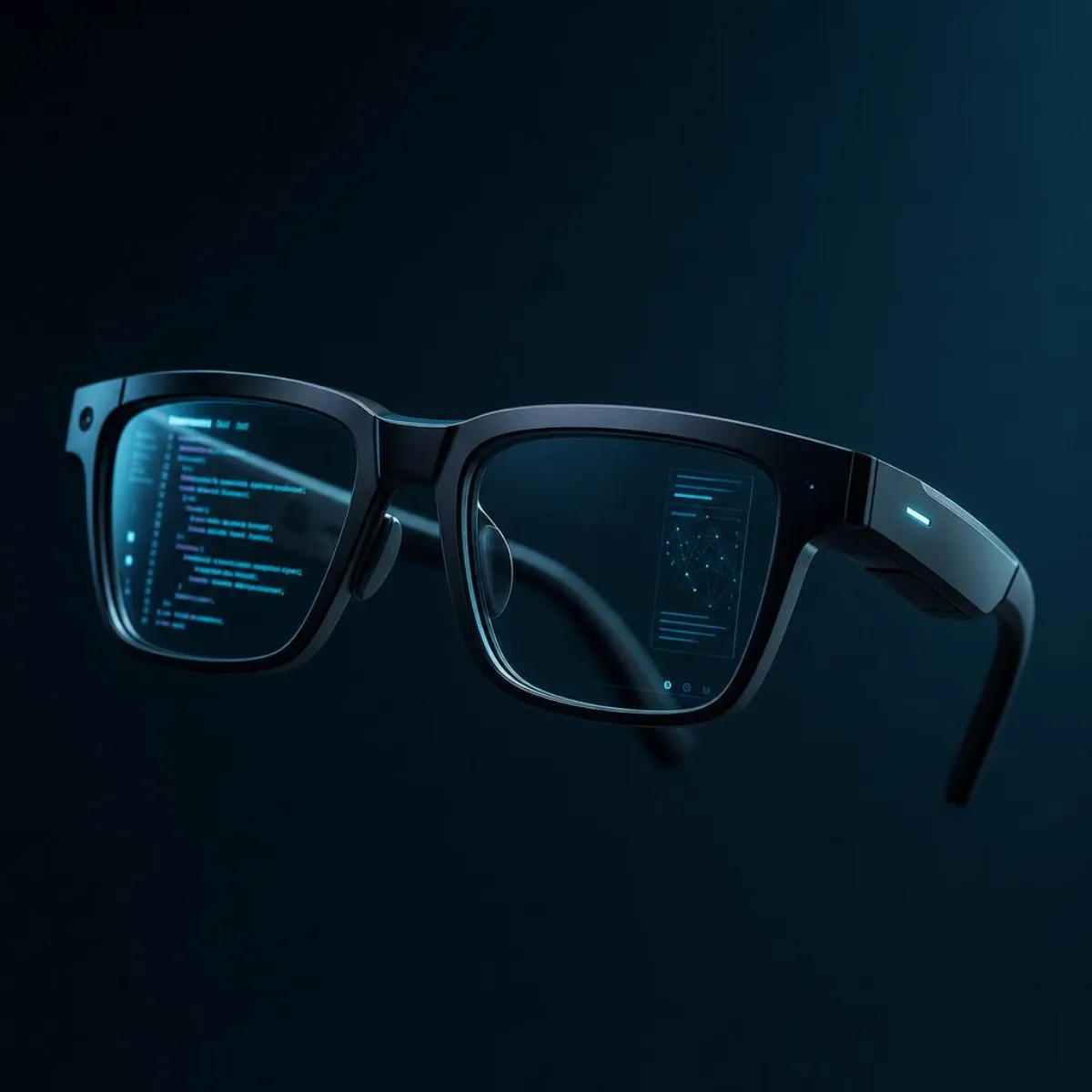
A startup called Monako has just launched a bet that sounds as absurd as it is inevitable: a pair of Linux-powered AI smart glasses, designed not for taking photos or watching videos on TikTok, but specifically for developers. The goal? To allow writing code, managing repositories, and executing complex engineering workflows directly through a wearable display, completely eliminating the need to open a laptop.
The desktop moves before your eyes
The concept behind Monako's glasses is not Apple Vision Pro-style augmented reality — heavy, expensive, and isolating. It is a focused and minimalist approach. Leveraging a lightweight Linux-based operating system, the hardware connects directly to advanced code-focused AI agents such as Claude Code and OpenAI Codex.
The work dynamic is completely flipped:
You no longer have to physically type every single line of code within an IDE (Integrated Development Environment).
You interact with the AI agent via voice commands, gesture input, or wearable micro-keyboards, viewing the software structure directly overlaid in your field of vision.
Artificial intelligence no longer acts as a simple 'assistant' (like Copilot on VS Code), but becomes the material executor that translates your logical intent into functioning software, showing you the results in real-time.
If we connect this trend to the recent Anthropic report — which highlights how models already write 80% of internal code — Monako's glasses are not a bizarre gadget, but the logical hardware consequence of software that is changing its nature. If the machine writes most of the code, humans no longer need a keyboard to strike pixels; they need a control center to oversee workflows.
From desk to pocket, from pocket to face
The history of computing is a constant trajectory of miniaturization and decompression of spaces. We reduced the power of old mainframes to bring it to desks, then we tucked it into our pockets with smartphones. The next step, like it or not, is to bring it directly before our eyes.
The theoretical advantages of this transition are clear in terms of mobility: the ability to debug a critical server while on a train or review a pull request while walking, without having to find a table or pull out a two-kilogram laptop.
But, as we are accustomed to doing on this blog, we must look beyond the enthusiasm of early adopters and analyze the real bottlenecks.
The cognitive overload trap
Programming is not like replying to an email or scrolling through a social feed. It is a high cognitive density activity that requires understanding complex architectures, navigating between different files, and deep concentration.
Isolating this information in a microscopic and wearable display raises enormous doubts about long-term sustainability:
Visual fatigue: Looking at textual code for hours on retinal projection screens or transparent displays is radically different than a 16-inch OLED panel.
The illusion of efficiency: Writing high-level code via an AI agent is great when everything works. But what happens when there is a need for a deep refactoring of an intricate logical bug? Are voice and a floating display enough to maintain the mental map of an entire software system?
An irreversible paradigm shift
Despite the doubts related to the first generation of this hardware, Monako's glasses draw a line of no return. They demonstrate that the tech industry is aware that the current human-computer interface is obsolete compared to the capabilities of generative artificial intelligence models.
The future of personal and professional computing is shifting toward invisibility. It will no longer be about buying the computer with the sharpest screen or the largest graphics card, but about choosing the lightest peripheral capable of connecting us to the flow of artificial intelligence. Laptops may not disappear tomorrow morning, but their centrality has just begun to falter.