The Ultimate Feedback Loop: The Era When Artificial Intelligence Writes Artificial Intelligence
In the world of software development, we have always considered code to be a product of human ingenuity. Developers write scripts to automate tasks, create platforms, or, in recent years, train Artificial Intelligence models. The line of demarcation has always been clear: man is the creator, the machine is the tool.
This paradigm, however, is collapsing under the weight of data.
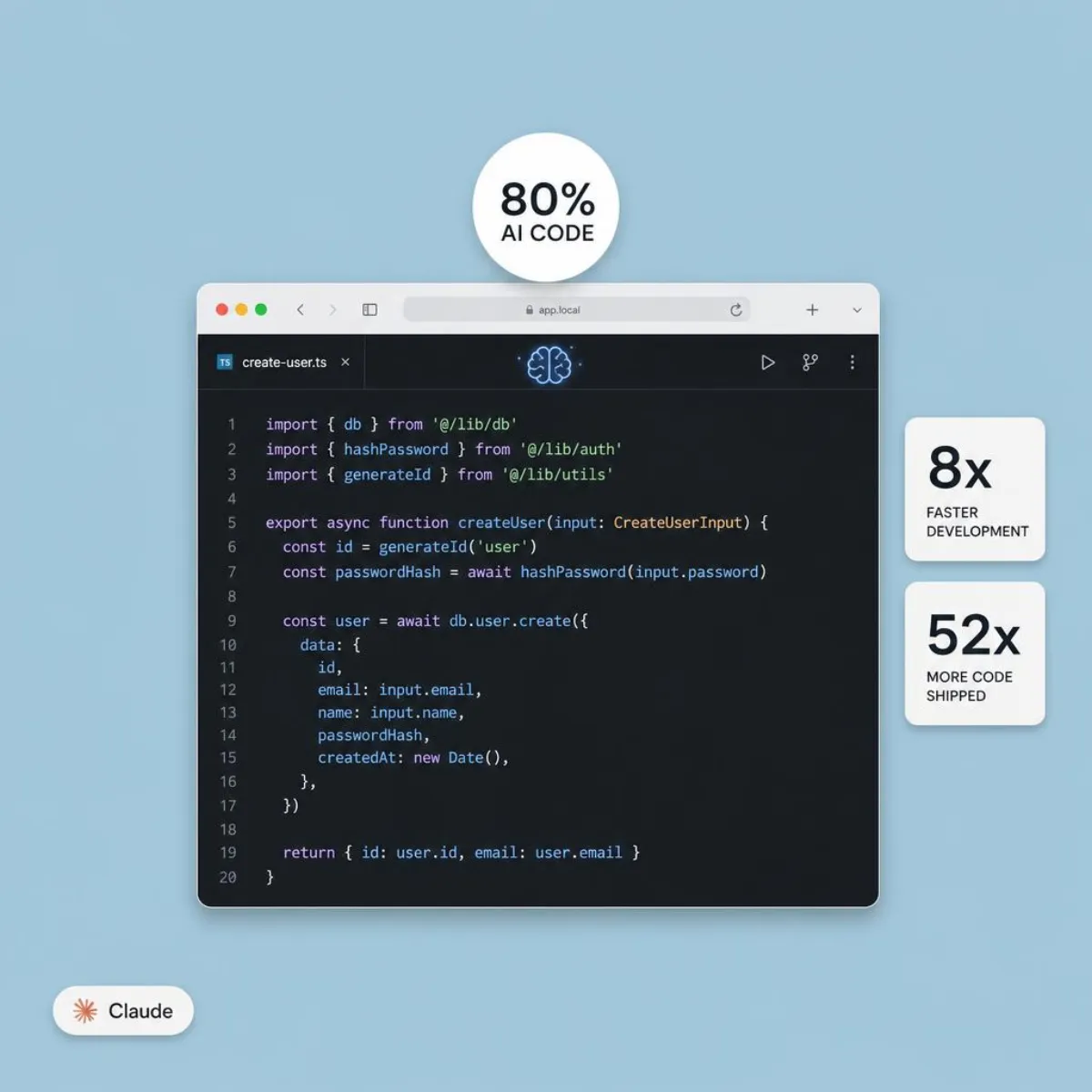
A recent and disruptive report published by Anthropic (one of the most advanced AI labs in the world, father of Claude) has revealed internal details that should make anyone involved in technology and investment reflect. We are not talking about future speculation or armchair philosophy about the Singularity. We are talking about raw engineering metrics: over 80% of the code entering Anthropic's systems is now generated directly by Claude. Thanks to the symbiosis with models, human engineers are producing 8 times more code than in the past. In a code optimization test used specifically to train future AI models, Claude achieved an efficiency increase of 52x.
We are witnessing the birth of the ultimate feedback loop. Software has begun to build and optimize itself.
What is Recursive Self-Improvement (and why it changes everything)
In AI research jargon, this phenomenon has a specific name: Recursive Self-Improvement. It is the theoretical concept where an artificial intelligence system is used to write, correct, and optimize a subsequent version of itself. This new version, being more intelligent, will be even better at optimizing the next version, triggering an exponential acceleration.
Until yesterday, this was a hypothesis confined to academic papers or cyberpunk novels. Today, Anthropic is telling us that the production pipeline of the most widely used commercial models in the world is already partially automated by those same models.
If we connect this phenomenon to what we have seen with hardware evolution — such as NVIDIA's RTX Spark chips designed specifically to handle native AI agents locally — we understand that technological infrastructure is moving at a speed that the human mind, used to thinking linearly, struggles to process.
The impact on the industry: the end of the 'traditional' developer?
When a company declares that 80% of its internal code is written by AI, the economic and structural impact on the software industry is inevitable. Those who think this simply means 'firing programmers' are looking at the finger rather than the moon. The real transformation concerns the very nature of work.
The engineer as supervisor: the 8x increase in efficiency shows that developers no longer spend their time writing boilerplate code or doing manual debugging. They become system architects, supervisors of logical flows orchestrated by machines.
The reduction of R&D costs: a 52-fold improvement in training code optimization means that the computational (and time) cost of producing more powerful models will fall drastically, leaving behind anyone who does not integrate AI into their development processes.
The big unknown: where does the loop stop?
Anthropic itself admits that we are not yet at the point of fully autonomous and out-of-control intelligence. There is still a fundamental bottleneck: human supervision, the quality of training data, and the physical limits of hardware.
However, the political and strategic message behind this report is clear. For years, institutions, governments, and investors have treated AI as a traditional software application — a tool similar to Excel or a database, just a bit more advanced. This is not the case. AI is the only technology in human history capable of actively accelerating its own evolution.
While venture capitalists continue to chase superficial metrics in pitch decks or fund startups that merely put a wrapper around third-party APIs, the real labs are changing the rules of the game at the root. If software begins to write itself, value will no longer reside in those who can write code, but in those who own the control flows, the infrastructure, and the ability to direct this infinite loop.
The future is not coming. It is self-programming.
Davide Stigliani
Full-stack developer and AI agent specialist — Tolve (PZ), Basilicata, Italy
I build AI agents, n8n automations and full-stack web applications for SMBs, connecting them to the ERP, CRM and channels the company already uses. I work across Italy and abroad, on site in Potenza and its province.