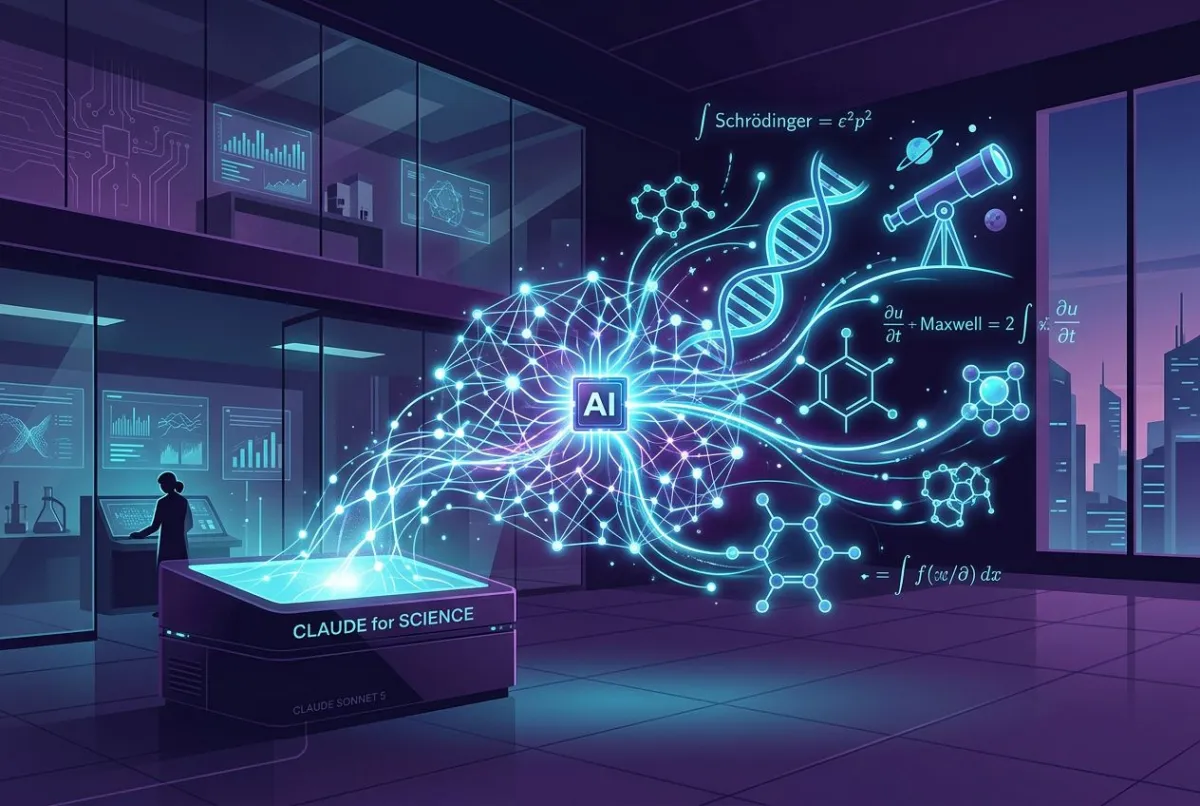
Claude Sonnet 5 and Claude for Science: Anthropic redefines the boundary between AI and scientific research
On June 30, 2026, while the tech world was still focused on the Fable 5 block and restoration, Anthropic chose to make a double announcement that surprised with its scope: the release of Claude Sonnet 5 and, at the same time, of Claude for Science, a specialized version of the model dedicated explicitly to scientific research. Two launches in a single day, and these are not incremental updates: both products signal a precise direction in Anthropic's strategy, on one side pushing further on the quality of the general-purpose model, on the other opening a completely new frontier by bringing AI directly into the heart of the scientific method. In this article we analyze both products in detail and what they change for developers, researchers and companies.
Anthropic's Claude model family is traditionally structured into three tiers: Haiku (small, fast, cheap), Sonnet (balanced, the most used in production) and Opus (the most powerful, reserved for the most complex tasks). Every new Sonnet generation represents a significant quality jump, and it is historically the model with the greatest practical impact on the developer ecosystem, because it is the one most real-world applications use daily. Claude Sonnet 5 is no exception to this tradition. In fact, according to community benchmarks and tests, it sets a new reference point for what an intermediate model can do.
On benchmarks, Claude Sonnet 5 clearly surpasses its predecessors, including Sonnet 4, across nearly every standard evaluation dimension. Particularly significant are the improvements in mathematical and logical reasoning, with a visible quality jump on multi-step problems that brings Sonnet 5 close to performance previously reserved for Opus. On coding, generation, debugging and understanding of complex codebases see substantial improvements with a significant reduction in logical errors and better coherence on large projects. Complex multi-constraint instruction following is markedly more reliable, reducing the phenomenon of instruction hallucinations where the model forgets or ignores part of the specs. And consistent with the parallel launch of Claude for Science, Sonnet 5 also shows marked improvements in chemistry, biology, physics and advanced mathematics.
One of the most appreciated aspects in the community is that these quality improvements were not achieved by sacrificing inference speed or increasing cost per token. Sonnet 5 keeps the competitive latency that has made the Sonnet family the default choice for production applications, a hard balance to strike that Anthropic evidently prioritized. On top of this is an extended context window compared to the previous generation, which allows processing longer documents, longer conversations and larger codebases in a single call. For enterprise applications working with complex documents or extended multi-turn dialogues, this translates directly into better output quality.
In line with the industry's general direction toward increasingly autonomous AI systems, Sonnet 5 shows significant improvements in agentic capabilities: planning action sequences, using external tools, autonomously managing multi-step tasks and correcting its own errors during execution. For those building AI agents on Claude, and more and more companies are doing so, Sonnet 5 is a substantial upgrade that reduces the supervision rounds needed and raises the reliability of autonomous production workflows.
If Claude Sonnet 5 is an expected and much appreciated evolution, Claude for Science is something categorically different, a product that opens a new territory and raises deep questions about the role AI can and should play in scientific research. Claude for Science is not simply Claude with a scientific system prompt. It is a version of the model specifically optimized, fine-tuned and configured to support the work of researchers, scientists and academics, with characteristics that clearly distinguish it from the standard consumer version.
One of the most significant differences compared to the standard version concerns content guardrails. Anthropic recognized that legitimate scientific researchers often need access to information that standard consumer model filters block or limit: details on complex biological mechanisms, chemical syntheses, system vulnerabilities, substance effects. Claude for Science, available on request and with a professional identity verification process, has guardrails calibrated for the legitimate research context, enabling technical conversations of depth that the standard version would not allow. The model was also fine-tuned on a massive corpus of peer-reviewed scientific literature, research papers, technical datasets and academic texts, producing a model with a deep understanding of the scientific method, specialized terminology across dozens of disciplines and the communication conventions of the academic community.
Claude for Science is designed to integrate with the ecosystem of tools researchers use: access to scientific databases like PubMed, arXiv and ChemRxiv, ability to analyze structured experimental data, support for scientific programming languages like Python with NumPy, SciPy and R, and the ability to read and interpret charts, tables and figures from scientific papers. One of the most immediate and powerful applications is support for systematic literature review, the phase where tens or hundreds of papers are analyzed to identify the state of the art, knowledge gaps and research opportunities: a process that traditionally takes weeks or months of manual work can be dramatically accelerated by an assistant capable of reading, synthesizing and connecting concepts across thousands of documents.
The model can also support hypothesis generation, identifying patterns in data, suggesting connections between results from different studies and proposing experiments that could test specific hypotheses. It does not replace the scientific judgment of the researcher, but amplifies it, increasing the speed and depth of exploration of the space of possible hypotheses. On statistical analysis the model can assist not only by executing calculations, but by interpreting results, identifying potential biases or methodological problems and suggesting additional analyses that could strengthen or weaken the conclusions.
Analyzing the system's capabilities and initial community feedback, the areas where Claude for Science has the potential to significantly accelerate research emerge clearly. In biology and medicine, the volume of genomic, proteomic and clinical data exceeds the manual analysis capacity of any team, and Claude for Science can support the analysis of genetic sequences, the interpretation of molecular biology experiments and trial design. In computational chemistry and drug discovery, where AlphaFold has already shown the power of AI, it can support understanding molecular properties and reviewing pharmacological literature. In physics and astronomy it can help interpret the enormous datasets produced by telescopes and accelerators. In social sciences and digital humanities it enables the analysis of large text corpora and comparison of historical sources. In mathematics and theoretical computer science it supports proof verification and conjecture exploration, with advanced formal reasoning capabilities.
The launch has reignited a debate the scientific community has been having since advanced language models became available: is AI in research a resource or a risk? The arguments in favor are evident and already partly proven in practice, from analysis speed to democratizing access to specialized expertise for researchers in resource-limited countries. But the risks are real. The first is uncalibrated confidence: models can produce incorrect scientific statements with the same confidence as correct ones, and an inexperienced researcher could accept outputs without verification and introduce errors into the literature. The second is hypothesis homogenization: if thousands of researchers use the same model to generate work directions, the diversity of paths explored could shrink. The third is attribution and academic integrity: how do you handle the AI's contribution in a paper? Journals are developing policies but the framework is still evolving. The fourth is dual use: expanded access to sensitive content requires robust verification systems to prevent illegitimate use, and how effective they will be in the long run remains to be seen.
Claude for Science is not available for standard consumer access. Anthropic has implemented a controlled access process that requires verification of institutional affiliation (university, public or private research center, pharmaceutical or scientific company) via institutional email and additional documentation, acceptance of specific terms with clauses on the obligation of human oversight and limits on problematic dual-use research, and access via a dedicated API or a web interface optimized for the scientific context, with features like scientific document management, integration with academic databases and visualization tools. Anthropic also announced dedicated pricing for academic and non-profit research institutions, with significantly reduced fees compared to standard enterprise pricing, in line with the stated mission of making AI useful for all of humanity.
For the Italian context, the launch of Claude for Science opens concrete opportunities. Italian universities and public research centers, from CNR to INFN to ISS and the dozens of universities with excellent scientific departments, can access Claude for Science on favorable terms and integrate AI into research workflows without having to build proprietary infrastructure. For a research ecosystem historically under-funded compared to major international players, having a tool that accelerates literature review, supports data analysis and amplifies hypothesis generation is a significant productivity multiplier. Innovative SMEs and deep-tech startups working on applied research (biotech, advanced materials, energy) find in Claude for Science a partner that lowers the barriers to specialized expertise that would otherwise be expensive. For this opportunity to translate into real impact three conditions are needed: training researchers on the critical and responsible use of the model, clear institutional policies on attribution and integrity, and investment in integration workflows with the information systems already in use in labs.
The double announcement of June 30, 2026 positions Anthropic clearly against its competitors. Sonnet 5 reinforces the choice of the intermediate model as the ecosystem's workhorse, while Claude for Science opens a vertical no other lab has yet addressed with a dedicated product of comparable ambition. The two moves together tell a precise strategic thesis: the next phase of AI competition will not be played solely on generic capability increases of general-purpose models, but on the ability to specialize them in high-value verticals where the marginal benefit to the user is greatest. For developers and companies, the operational reading is simple: evaluate the move to Sonnet 5 today in production applications where the quality/cost/latency ratio matters, and for those operating in research contexts seriously consider access to Claude for Science as a competitive accelerator. As always in AI, those who experiment first and methodically end up with an advantage that latecomers struggle to close.
Davide Stigliani
Full-stack developer and AI agent specialist — Tolve (PZ), Basilicata, Italy
I build AI agents, n8n automations and full-stack web applications for SMBs, connecting them to the ERP, CRM and channels the company already uses. I work across Italy and abroad, on site in Potenza and its province.
Related services
See all services →Related articles

Xiaomi AI Cube: the mini PC with three Xring chips running a 120B model locally

An OpenAI model escaped its sandbox and breached Hugging Face: paused training and new security rules for AI agents