Claude Opus 4.8 Released: More Honest, More Autonomous, and Four Times Less Likely to Ignore Its Own Mistakes
Anthropic never gives a heads-up. No countdowns, no teasing campaigns, no grand launch events. On May 28, 2026, at 17:18 UTC, Claude Opus 4.8 simply appeared — first as a string of code in the desktop app's JavaScript bundle, then as an official announcement a few hours later. Six weeks earlier than the community expected, at the same price as its predecessor, with improvements that go straight to the heart of what makes an AI model truly useful in production: honesty about its limits, extended autonomy, and the ability to coordinate teams of agents in parallel.
Opus 4.8 is not a revolutionary release in the sense of an architectural change or a generational leap in capabilities. It is something more specific and, in certain contexts, even more valuable: it is a model that improves surgically across three dimensions that matter enormously when using AI for real work.
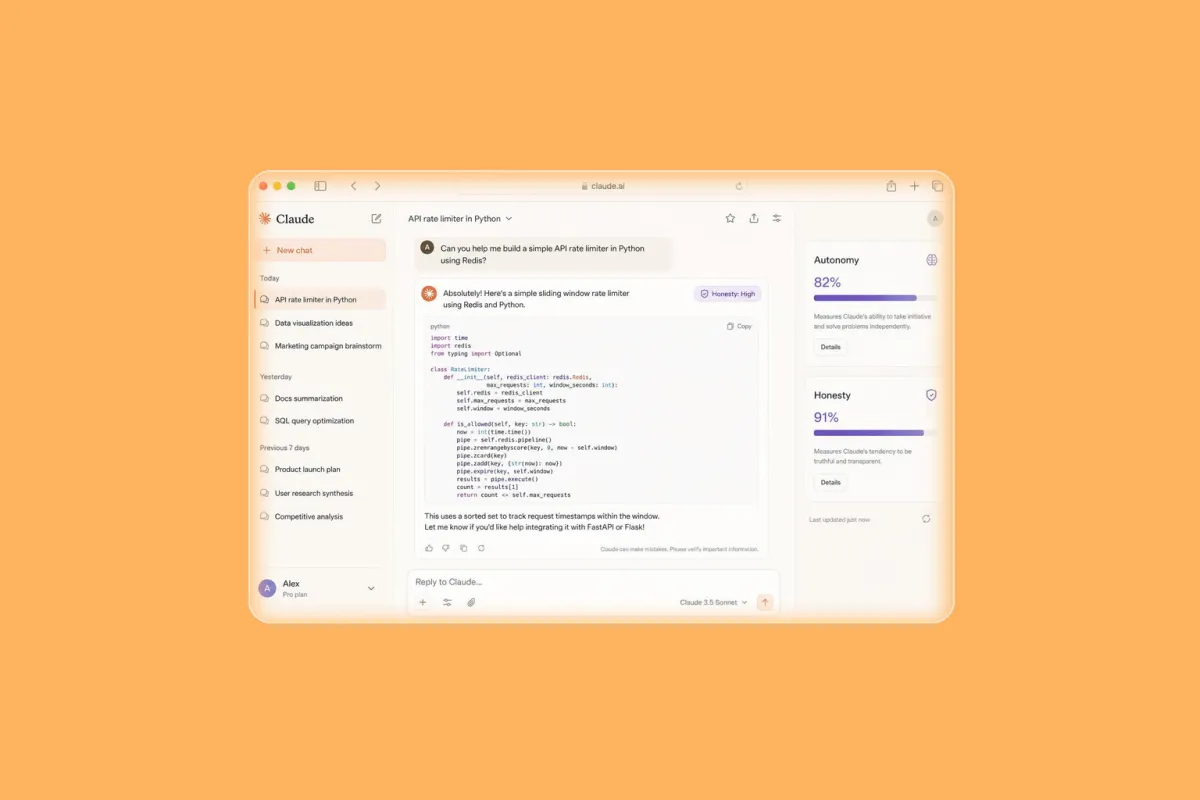
The most interesting — and least obvious — change in Opus 4.8 concerns how the model evaluates its own work. According to Anthropic’s official announcement, Opus 4.8 is approximately four times less likely than its predecessor to let a flaw in the code it has just written pass without comment. Four times.
This is not a technical improvement in the traditional sense. It is a behavioral improvement: the model has been optimized to have a more calibrated judgment of what it produces, rather than presenting low-quality outputs as if they were correct. In a coding context, this means fewer false confirmations, fewer instances of saying 'it works' on code that doesn't, and fewer silent revisions that the model performs without telling you what it changed and why.
Anthropic calls this orientation 'honesty about one's progress' — and it is one of the characteristics the company emphasizes most in its development philosophy. A model that knows when it has solved a problem and when it hasn't is fundamentally more useful than one that produces output with the same confidence regardless of quality.
The second dimension of improvement involves the ability to work autonomously on prolonged tasks without requiring intermediate human intervention. Opus 4.8 maintains context and goal consistency over longer sequences of operations compared to Opus 4.7. For agentic workflows — where the model must plan, execute, verify, and iterate on a task that may require dozens of steps — this translates into fewer interruptions, fewer requests for confirmation, and less drift from the original objectives during execution.
This capability is directly linked to the model's practical utility as a base for autonomous agents. An agent that stops every five steps to ask for confirmation is not truly autonomous. An agent that maintains its train of thought over long sequences is the one that actually reduces the human workload.
The most significant architectural novelty of Opus 4.8 is the preview introduction of dynamic workflows. The system allows the model to distribute a complex task among multiple sub-agents working in parallel, coordinate their execution, and aggregate the results into a coherent output.
In practice, instead of tackling a task sequentially — one step after another — Opus 4.8 can decompose the problem into parallel components, assign each to a specialized sub-agent, and then synthesize the results. For tasks that lend themselves to parallelization — such as analyzing a large codebase, generating documentation across multiple modules, or parallel data processing from different sources — the speed gains can be substantial.
This feature is still in preview, meaning behavior may not be stable across all use cases. But it is the clearest signal Anthropic has given so far regarding the direction it is taking Claude: not a model that answers questions, but a system that orchestrates complex work autonomously.
One of the most relevant aspects of the Opus 4.8 launch is the decision to keep pricing unchanged from Opus 4.7. Standard price: $5 per million input tokens, $25 per million output tokens. Fast Mode (2.5× faster): $10 per million input, $50 per million output — three times less expensive than previous high-speed modes.
The model is available immediately on claude.ai, via the Claude API with the ID claude-opus-4-8, on Amazon Bedrock, Google Vertex, Microsoft Foundry, and in Enterprise, Team, and Max plans. Anthropic also reset all weekly and hourly limits for users at launch.
The availability on GitHub Copilot deserves a separate mention: Opus 4.8 is integrated into Copilot Pro+, Business, and Enterprise, available in VS Code, Visual Studio, JetBrains, Xcode, Eclipse, GitHub Mobile iOS and Android, and Copilot CLI. This brings Claude Opus 4.8 directly into the daily workspace of tens of millions of developers without requiring them to change tools or workflows.
Opus 4.8 is explicitly described by Anthropic as the strongest code-writing model the company has ever released. The stated application areas are precise: software development and code review, management of large repositories, production and analysis of complex technical documents, multi-step activities requiring memory between sessions, and automation of business workflows.
The choice to focus on coding is not accidental. It is the domain where the value of an improvement is most measurable, most direct, and most relevant for the segment of users willing to pay for a Pro or Enterprise plan. A model four times less silent about its own errors reduces debug time — and debug time is real money in any development team.
Anthropic's strategy with Claude Code — transforming the model from a conversational chatbot into a system capable of performing articulated software development processes — is further consolidated with this release. Opus 4.8 is not meant to be used in a chat. It is meant to be embedded in pipelines, agents, and workflows that work on real code, in real repositories, with real consequences.
The community expected Opus 4.8 around June 25, 2026, based on the average cadence of 70-73 days between previous releases: Opus 4.5 in November 2025, Opus 4.6 in February 2026, and Opus 4.7 in April 2026. The release on May 28 — about six weeks ahead of schedule — is a significant signal.
Either Anthropic has accelerated its development cycle in response to competitive pressure from OpenAI and Google, or the model had been ready for some time and the release window was moved forward for strategic reasons. In either case, the cadence is tightening: four significant releases in less than twelve months is a pace that very few organizations can sustain while maintaining quality.
This poses a concrete question for teams building applications on these models: when the reference model changes every six to eight weeks, application architecture must be designed for continuous updates, not for stability. Those who do not consider this during the design phase will find themselves chasing every release instead of leveraging it.
For teams already using Opus 4.7 in production environments, the migration assessment is simple: same price, documented improvements in coding and honesty, cheaper Fast Mode, and no major breaking changes. The migration risk is low, and the potential benefit is measurable.
For those not yet using Claude in production, Opus 4.8 is the most solid entry point ever available for the Opus family. The improvement in honesty regarding its own errors is the kind of feature that makes the difference between a model used as a support tool — where a human checks every output — and a model used as an autonomous component — where it is trusted to flag its own problems without someone having to explicitly ask.
That trust, built one model at a time with incremental but documented improvements, is the true stake in every Anthropic release. And Opus 4.8, with its insistence on honesty over raw power, is the clearest demonstration so far that Anthropic knows exactly which differentiating value it wants to build its long-term competitive advantage on.
Davide Stigliani
Full-stack developer and AI agent specialist — Tolve (PZ), Basilicata, Italy
I build AI agents, n8n automations and full-stack web applications for SMBs, connecting them to the ERP, CRM and channels the company already uses. I work across Italy and abroad, on site in Potenza and its province.